

MSc/PgDip Audio Production
- Course type
- Postgraduate
- Course qualification
- MSc/PgDip
Course summary
What is the fee?
For all course options, see fees and funding
Where will I study?
MediaCity campus
How long will I study?
Full-time: One year
Part-time: Three years
International students accepted?
Yes, available to international students
Overview
New technologies are changing the way people experience sound and audio. With our specialist Audio Production postgraduate degree, you’ll gain practical, theoretical and creative experience of sound engineering, sound innovation, music production and audio technology.
Our course is designed to develop your professional audio skills, backed up with thorough theoretical knowledge about its design, management and production across many platforms. During your studies, you will get to use advanced recording studios, music technology suites and acoustics facilities at our MediaCity and Peel Park campuses.
We highly recommended the course for audio technology and engineering graduates who want to pursue a career in the audio and media industries. By building on your engineering and technology fundamentals, you can gain specialist knowledge and expand your skill set, positioning you for an exciting career in sound, music and media industries.
A new home for acoustics – opening 2027
Scheduled for opening mid-2027, our new Acoustics Building will be one of the world’s most advanced centres for studying, testing and shaping sound. Featuring some of the quietest rooms on the planet and cutting-edge labs for everything from whisper-level measurements to full-scale vehicle and engine testing, the new building is part our multi-million pound Campus Connectivity plan and will give students unparalleled access to world-class facilities driving the future of sound, technology and research.
International applicant? Please check international intakes for the latest information and application dates.
Pathway to Postgrad
Meet us in person at our Open Day to get a closer look at what studying here could mean for you. Or explore our other Pathway to Postgrad events taking place throughout November, with options to meet us online and on campus.
You will:
- Study at our sophisticated MediaCity campus, next door to the BBC and ITV
- Utilise advanced, state-of-the-art recording studios and post-production facilities to study audio engineering and production
- Develop advanced skills relevant to the contemporary communication, media and entertainment industries
- Tap into the expertise of world-class audio engineering and acoustics researchers and academics
This is for you if...
You are a technically-skilled graduate with a degree in audio, music technology or a related subject area, and want to build audio production knowledge
You want to further develop your existing theoretical and operational audio production skills and knowledge
You're excited by sound, and want a future career in the production of audio
School of Science, Engineering and Environment.

Rising to the challenge of a changing world, our postgraduate courses are designed to shape the next generation of urbanists, scientists, engineers, consultants and industry leaders.
Driven by industry, and delivered by supportive programme teams, you can develop the knowledge and skills to take your career potential further.
FACILITIES

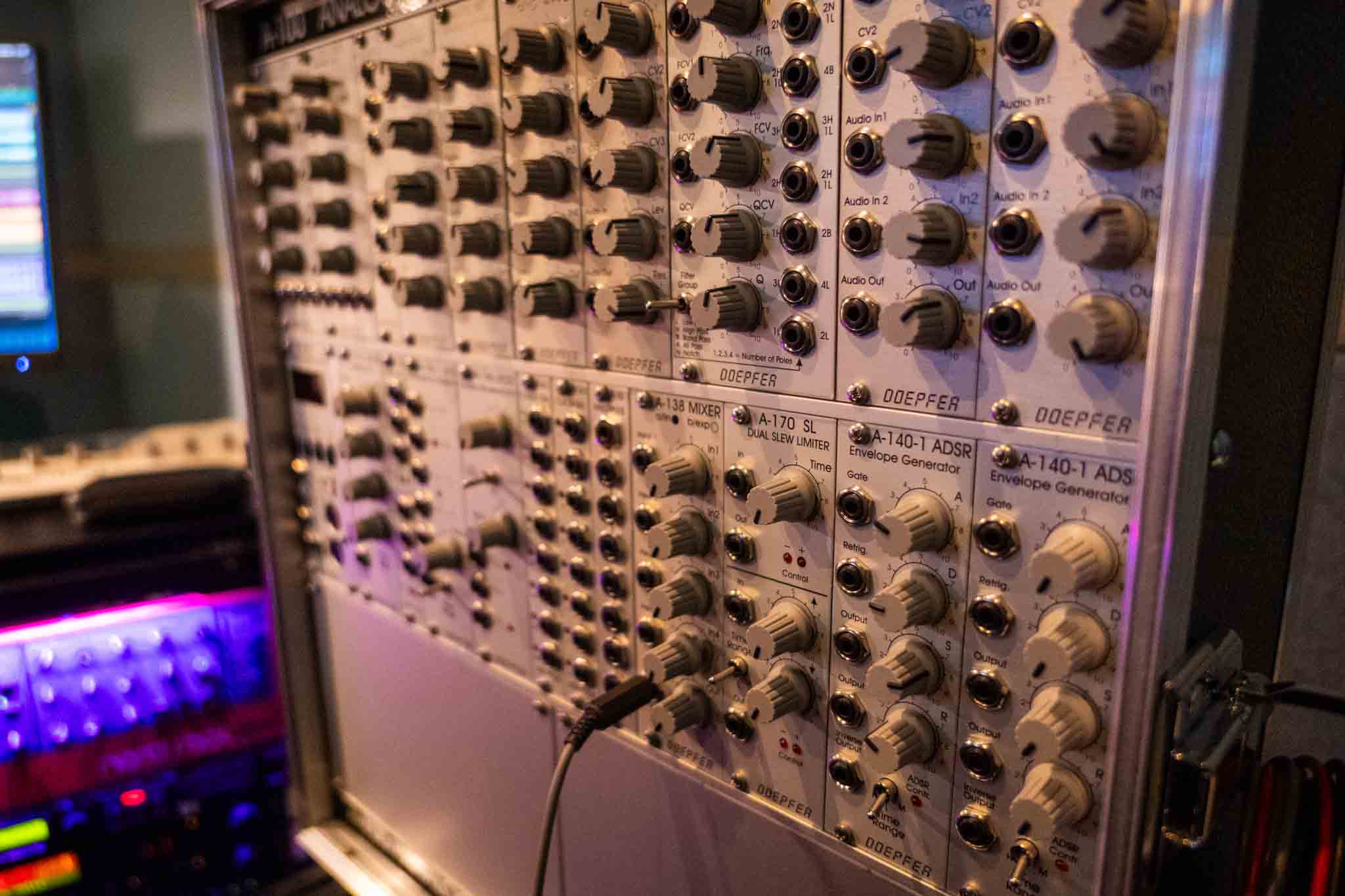
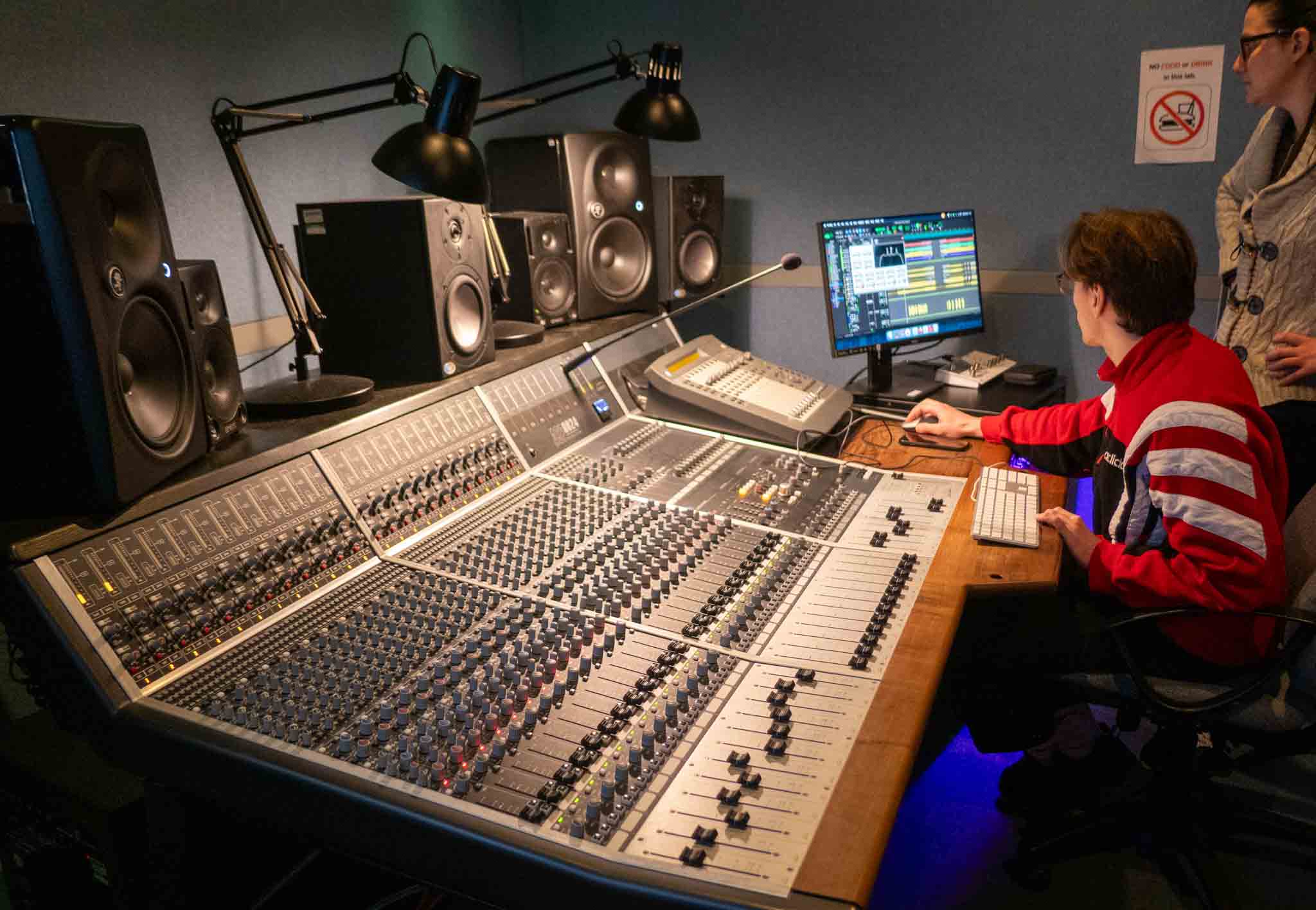
As an Audio Production student you will use our post production and audio suites featuring industry-standard software packages including Pro Tools, Reason, Adobe Creative Cloud and the Native Instruments suite. The post-production suite includes Pro Tools S6 console and has Dolby Atmos monitoring capabilities. Our recording studios house Solid State Logic, Neve and Audient mixing consoles. There are also dedicated dubbing and foley facilities.
Industry collaboration and research

When you start this degree with Salford, you are also joining a community making a difference in industry, our local region and in our wider society.
Many of our academics and technicians who support your course also deliver collaborative, interdisciplinary, high-impact work in a range of local and global issues and challenges with noise, sound and vibration.
Read on and discover how you are part of something bigger.
How you'll learn
What will I be doing?
Teaching
The majority of teaching and learning is delivered through tutorials, seminar groups, and studio-based activities in the recording studios, the audio technology suite, and audio post-production suite.
All students benefit from the supply of a range of high-quality teaching materials, books and software. Interaction is face-to-face wherever practical, and there is a strong focus on guided self-learning.
Assessment
Assessment involves a mixture of practical work, report writing, and project work. By the end of the course, you will have a portfolio of audio and new media work to demonstrate to future employers.
Assessment is approximately divided as follows:
- Practical work (30%)
- Report/assignment (35%)
- Presentation (5%)
- Dissertation - that may entail practical elements (30%)
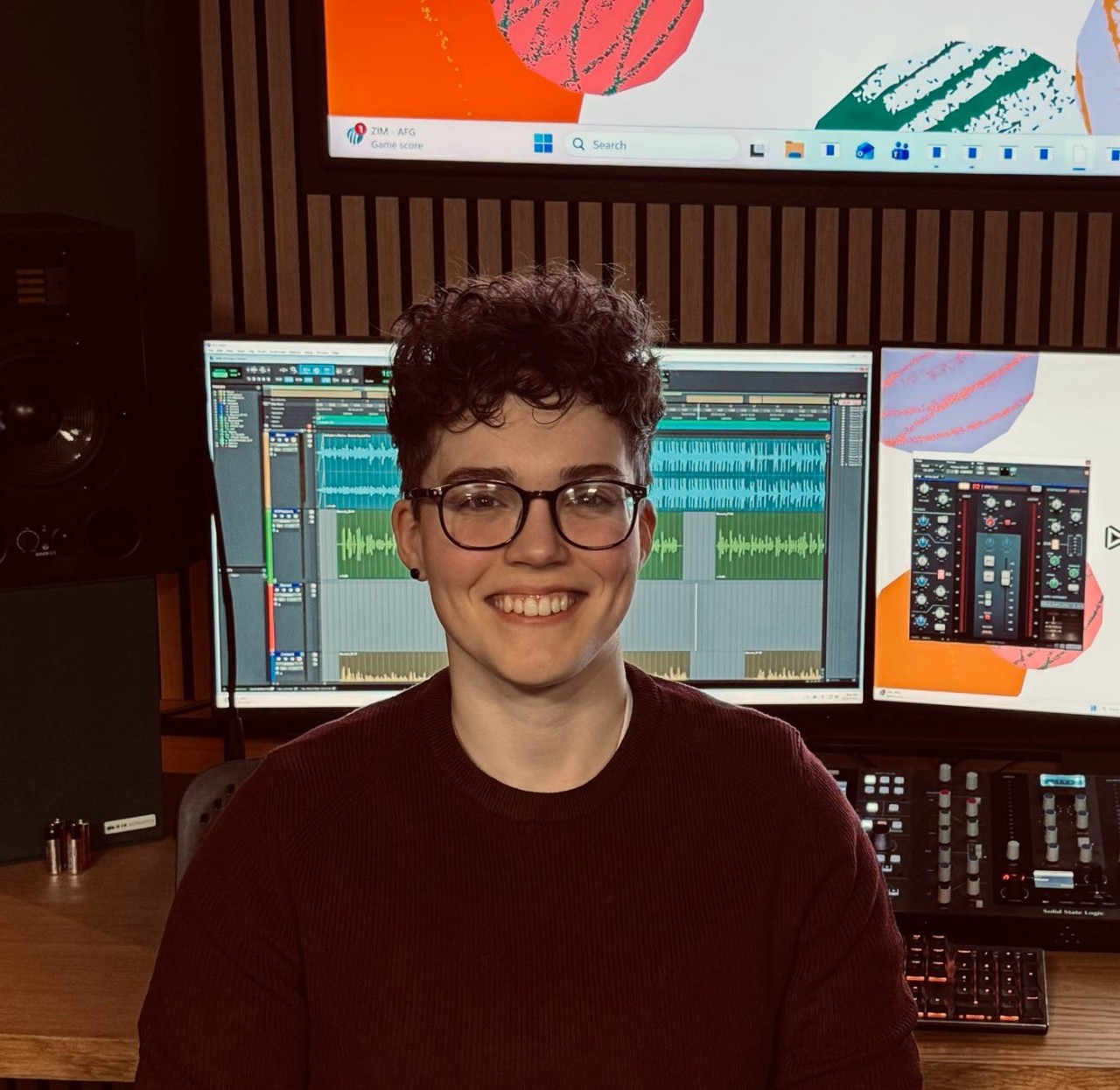
The course exposed me to a wide range of specialisms within the industry and helped me define my career goals and now supports my role managing a global roster of over 600 voiceover artists. Completing the MSc was transformative. It provided both the knowledge and the network that have enabled me to build a fulfilling career as a Senior Producer in the audio branding industry, a role that challenges me, inspires me and allows me to keep learning every day.
Future careers
Employment
The growth of digital media has increased industry demand for talented professionals who can help deliver exceptional audio-visual experiences and drive sound innovation. Salford has over 25 years of experience nurturing graduates into audio and acoustics careers that span consultancy, research, development and design roles with leading companies such as Apple, Dolby, and the BBC.
Our audio production graduates typically build careers in audio post-production, freelance sound engineering, convergent technologies (audio, video and new media) and broadcast. Today, you'll find alumni working with leading media organisations including the BBC, Sky TV and Channel 4.
Further study
You might also choose to take your subject interest further with postgraduate research. Our Acoustics Research Centre is home to PhD and Research Master’s opportunities exploring a range of topics, including noise and soundscapes, sound modelling, psychoacoustics, vibro-acoustics, building acoustics, acoustic materials, sound innovation and audio engineering.
Explore our Doctoral School to learn more about research training, support and opportunities.
Career Links
Industry collaboration is at the heart of your learning at Salford. Thanks to a longstanding partnership with Soundsnap, you will have free access to sound effects resources during your studies.
Our acoustic and audio staff hold strong industry links through collaborative research and development projects with our Acoustics Research Centre. These connections keep course content relevant to industry needs and in tune with new research.
Recent collaborative projects include integrated virtual models for acoustic design with Dyson, wind turbine noise auralisation and subjective testing with DELTA and DEFRA, acoustics for auralisation with Arup, the S3A Future Spatial Audio project with the BBC and SALSA (Spatial Automated Live Sports Audio) system with DTS and Fairlight.
We also hold regular informal research seminars with industry partners to share research outputs. Recent masterclasses include acoustic consultancy with RBA Acoustics, noise mapping software with Cambell Associates, environmental noise with WSP/Parcel, railway noise & vibration with AECOM, NVH & infotainment with JaguarLandRover, and measurement microphone technology with GRAS.
Modules
Course delivery
Our MSc Audio Production postgraduate course is available with flexible full and part-time pathways. There are course intakes each September and January.
The MSc award course comprises eight 15-credit taught modules, followed by a 60 credit dissertation project.
- As a full-time student starting in September, your studies will take approximately 12 months to complete. Full-time January starts will take approximately 16 months to complete. You will study taught modules in trimesters one and two, and complete your final project during trimester three
- As a part-time student, your studies for both start dates will take approximately 36 months to complete. Taught modules are spread over trimesters one and two for two years, and you will complete your final project in year three
The part-time pathway can be intensive. We recommend that part-time students dedicate approximately 19 hours per week to study.
Modules are delivered at our MediaCity and main campuses using recording studios, audio technology suites, post-production suites, acoustic facilities and lecture suites.
The course timetable is designed to allow students with other commitments to structure their week around teaching sessions.
During the 2024/25 academic year full-time students are on campus for 4 days per week, Tuesday to Friday, in Trimester 1 and 2 days per week, Wednesday and Thursday, in Trimester 2. Part-time students will have their modules split over two years.
Learn more about the current course modules in the section below.
Course team
Drawing on over 60 years of acoustics expertise at Salford, the Audio Production postgraduate course is delivered by an academic team with exceptional research experience and extensive professional connections throughout the world.
Course leader: Dr. Ben Shirley
Trimester one
Audio Production
The Audio Production module is delivered through a series of lectures and practical sessions within one trimester. The material covered in the lectures will be demonstrated and explored via practical exercises and group recording sessions within the Newton Recording Studios. You will cover up-to-date recording and music production techniques - essentially everything needed for making great sounding, pro level recordings and finished mixes. The knowledge and experience gained will help provide a very firm foundation and understanding for progression into audio related industries. The weekly lectures will consist of specific in-depth recording topics for the week, followed by practical hands-on studio sessions where you will work on engaging exercises and recording projects. There is a heavy focus on achieving pro level standards in the module.
Emerging Technologies and Digital Culture
In this module you will be introduced to a range of emerging audio technologies while developing your online portfolio and professional skills. As this is a rapidly evolving field the core technologies are reviewed each year, but the focus is on developing your knowledge, understanding and skills around innovations in production and broadcast. Combining hands-on and theoretical approaches, this module is designed to further your cutting-edge skillset while developing your understanding of the cultural and business impacts of emerging audio technologies. You will demonstrate your knowledge and skills through the production of a series of audio-related projects presented via your online portfolio.
Broadcast Audio
You will explore the core principles and technical terminology used in professional audio broadcast and production environments. This module introduces you to digital audio file formats, delivery methods, and data transfer protocols essential for modern workflows. You’ll gain an understanding of synchronization techniques, including timecode and clocking systems, and learn how to apply current industry standard, e.g. AES, SMPTE, ITU. Through critical listening exercises, you’ll also engage with recognised subjective audio evaluation methods (including BS1116 and ITU-R BS.1534-3), helping you develop a trained ear for high-quality sound. By the end of this module, you’ll be equipped with the foundational knowledge and technical confidence required to understand and configure broadcast and production audio systems to professional standards.
Audio Post Production
This module covers the tools and techniques used in the audio post production process and how to apply these skills in an original and creative way by developing the advanced skills and techniques needed for sound design, dialogue editing, ADR (automatic dialogue replacement) and Foley work. You will also develop a systematic understanding of mixing for 5.1 surround and to apply these in an original and creative way and be able to develop mastering techniques in stereo and 5.1. On completion you should have the skills and techniques needed to produce broadcast-standard output.
Trimester two
Recording Studio Design
You will learn the acoustics of sound propagation in enclosed spaces and will learn how to design methods of treating such spaces to achieve a desired acoustic result and the limitations of those methods. An assignment based on the design of a creative space (recording or control room) will tie all these strands together so that you can understand the acoustics, engineering and management required in the successful design of both control rooms and other creative audio environments.
Sound Synthesis
You will develop theories of timbre analysis, the ways in which musical instruments produce sound, musical synthesis techniques, then undertake software-based musical sound synthesis using both emulative and abstract approaches. Additive, subtractive and modulation synthesis will be studied along with signal processing (effects) design. By the end of this module, you will have built a complex synthesizer and multi-effects unit in software.
Research Methods
In this module you will devise, design and document a small-scale research project. A mixture of lecture and seminar sessions will be used to introduce the idea of doing research and the methods and theoretical frameworks needed to design a successful project. You will develop your understanding of the importance of interdisciplinary research, and the value of using different methods to elicit different types of data, leading to a well-informed research project proposal and design. You will work in small groups to develop your understanding of a range of research methods. You will be supported by weekly discussion sessions and guest lectures from established researchers.
Spatial Audio
The spatial hearing capabilities of humans are investigated and spatial audio systems including stereo, binaural, transaural, multichannel stereo, ambisonics and wave field synthesis are examined in both theory and practical use. There are opportunities to audition and experiment with different surround sound systems in practical sessions.
Trimester three
Project
The aim of the master's project is to carry out, under supervision, an extended individual study into a topic in audio, digital media or acoustics. A large number of topics will be offered to you to choose from or you could undertake a bespoke topic to be agreed between you and your supervisor. Your project will reflect the skills, knowledge and understanding from different areas of the course and will encourage initiative and project management.
We take a flexible approach to our course delivery that promotes diversity and inclusivity and provides a blended learning experience, which will vary to meet specific programme requirements. This learning time includes formal lectures and interactive activities such as seminars, tutorials, practical sessions, laboratory and studio learning. Smaller classes may be used to support collaborative activities such as project and group work and presentations. A range of different assessments and feedback is offered to meet the needs of both our diverse student body and specific subject needs.
Our postgraduate taught courses are normally made up of 30 credit modules which are equal to 300 hours of learning time, or 15 credit modules which are equal to 150 hours of learning time. A Master’s degree typically comprises 180 credits, a PGDip 120 credits, and a PGCert 60 credits.
Please note that exact modules and content offered may vary in order to keep content current and, for courses that offer optional modules, may depend on the number of students selecting particular options. When accepting your offer of a place to study on a programme with optional modules, you should be aware that optional modules may not all run each year. Your tutor will be able to advise you as to the available options on or before the start of the programme. Whilst the University tries to ensure that you can undertake your preferred options, it cannot guarantee this.
Entry requirements
Applicant profile
This course is recommended for sound engineering or music technology graduates or working professionals with a keen interest in the subject area. Applicants will require skills in both the operational and theoretical aspects of audio production.
English language requirements
All of our courses are taught and assessed in English. If English is not your first language, you must meet our minimum English language entry requirements. An IELTS score of 6.0 (no element below 5.5) is proof of this, however we do accept a range of equivalent qualifications.
Read more about our English language requirements, including information about pathways that can help you gain entry on to our degree courses. If you do not have the English language requirements, you could take our Pre-Sessional English course.
International applications
Please check international intakes for the latest information and application dates.
Standard entry requirements
Undergraduate degree
A second class honours degree that must contain significant elements of audio technology or production.
International student entry requirements
We accept qualifications from all around the world. Find your country to see a full list of entry requirements.
Alternative entry requirements
Accreditation of Prior Learning (APL)
We welcome applications from students who may not have formal/traditional entry criteria but who have relevant experience or the ability to pursue the course successfully.
The Accreditation of Prior Learning (APL) process could help you to make your work and life experience count. The APL process can be used for entry onto courses or to give you exemptions from parts of your course.
Two forms of APL may be used for entry: the Accreditation of Prior Certificated Learning (APCL) or the Accreditation of Prior Experiential Learning (APEL).
For more information or enquires about this scheme, please contact: ScienceAdmissions-PG@salford.ac.uk
Fees and funding
Tuition fees are calculated pro rata based on the full Master’s programme rate. PGDip fees will vary proportionally to the number of credits you study, as these qualifications require fewer credits to complete than a full Master’s degree.
2027/28
| Type of study | Fees |
|---|---|
| Full-time | £10,800 per year |
| Part-time | Part-time fees are calculated on a pro rata basis |
2027/28
| Type of study | Fees |
|---|---|
| Full-time | £18,000 per year |
Additional costs
You should consider further costs which may include books, stationery, printing, binding and general subsistence on trips and visits. International student scholarships If you are a high-achieving international student, you may be eligible for one of our scholarships. Learn more about our latest international scholarships.