

MSc/PgDip Acoustics
- Course type
- Postgraduate
- Course qualification
- MSc/PgDip
Course summary
What is the fee?
For all course options, see fees and funding
Where will I study?
Peel Park campus
How long will I study?
Full-time: One year
Part-time: Two and a half years
Distance learning: 32 months
International students accepted?
Yes, available to international students
Overview
Help to build a better sounding world with a postgraduate MSc Acoustics degree.
Delivered in full and part-time study pathways, either on campus or online, we've designed a course to nurture your specialist knowledge, so you're ready to develop a career as a future leader in audio product development, noise consultancy, sound innovation or sound management.
Recommended for numerate science graduates looking to join the acoustics and audio profession, you will benefit from using world-class facilities learning alongside an academic team at the forefront of industry-focused research.
A new home for acoustics – opening 2027
Scheduled for opening mid-2027, our new Acoustics Building will be one of the world’s most advanced centres for studying, testing and shaping sound. Featuring some of the quietest rooms on the planet and cutting-edge labs for everything from whisper-level measurements to full-scale vehicle and engine testing, the new building is part our multi-million pound Campus Connectivity plan and will give students unparalleled access to world-class facilities driving the future of sound, technology and research.
Pathway to postgrad
Meet us on campus at our Open Day, or chat to our tutors online to get a closer look at what studying here could mean for you.
It’s all part of Pathway to Postgrad – a series of events designed to give you clear guidance, real support, and opportunities to find out more as you take your next step into postgraduate study.
You will:
- Follow a structured postgraduate training programme in acoustics, with specific focus on the technologies and principles associated with industrial applications
- Gain a detailed knowledge, systematic understanding and critical analysis of acoustical concepts, along with the ability to apply these concepts to practical problems of engineering design and analysis
- Build practical skills in measurement as you develop the ability to critically evaluate new developments within the field and contribute to the development of acoustics through research and project work
- Shape your learning based on your interests or career plan by choosing options that include psychoacoustics, environmental noise measurement, immersive sound reproduction, sound innovation and noise and vibration control
- Learn alongside research-active academics and technicians, using some of the UK’s leading acoustics facilities that are regularly used by major organisations to test and develop audio and acoustics products
This is for you if...
You are a technically-skilled, numerate graduate with a degree in an engineering or science discipline
You wish to develop skills for an acoustics and audio engineering career
You are currently working in the audio and acoustic industry and wish to expand your expertise
School of Science, Engineering and Environment.

Rising to the challenge of a changing world, our postgraduate courses are designed to shape the next generation of urbanists, scientists, engineers, consultants and leaders.
Driven by industry and delivered by supportive programme teams, you can develop the knowledge and skills to take your career potential further.
Facilities

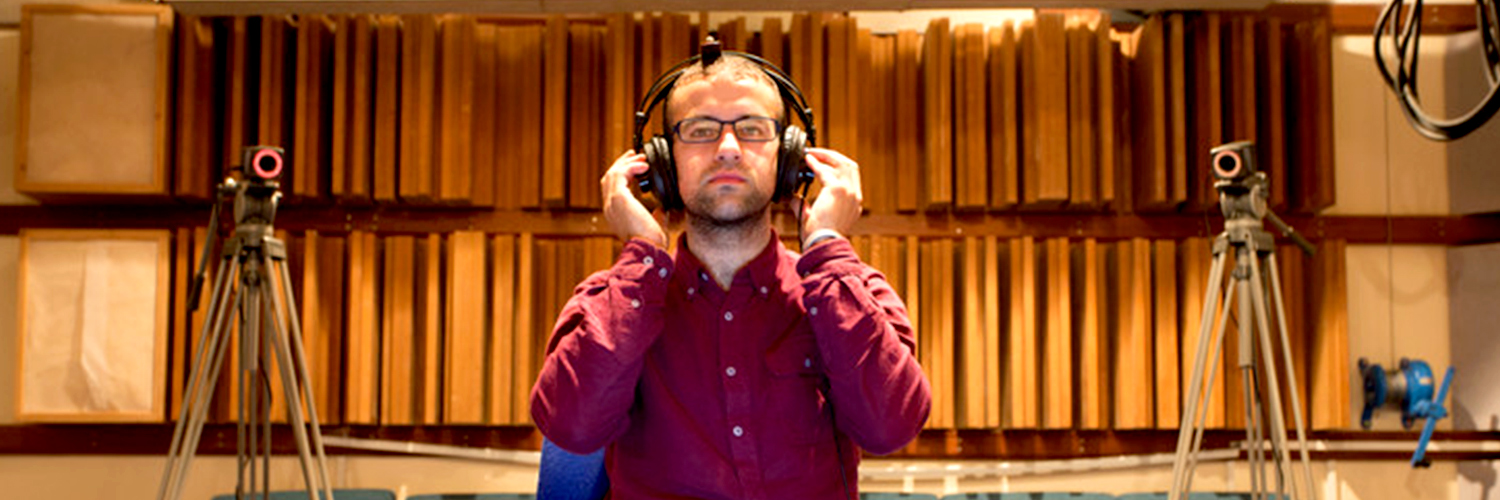
Acoustic and audio test facilities at Salford are second to none. We have a full range of specialist test chambers: full anechoic chamber, two semi-anechoic chambers, transmission suite, two large and one small reverberation chamber, ITU standard listening room, audiometric test facilities and a range of modern instrumentation and equipment.
We are accredited to perform no less than twelve types of test and the test chambers are maintained by a team of commercially funded technical staff. We also have a UKAS accredited Calibration Laboratory which provides a full-scale commercial service to industry. All these facilities are available for students carrying out projects.
Industry collaboration and research

When you start this degree with Salford, you are also joining a community making a difference in industry, our local region and in our wider society.
Many of our academics and technicians who support your course also deliver collaborative, interdisciplinary, high-impact work in a range of local and global issues and challenges with noise, sound and vibration.
Read on and discover how you are part of something bigger.
How you'll learn
Future careers

Employment
Acousticians with engineering, science and mathematical skills are in short supply, which puts you in a strong position to build a career once you graduate.
Our MSc/PgDip Acoustics postgraduate degree can up careers where you can lead and influence acoustics and audio engineering research, broadcast engineering, loudspeaker and audio system design, sound innovation and consumer audio product development.
In our increasingly busy world, managing unwanted noise is a growing and significant problem. You might choose to use the knowledge and skills developed on the course in a consultancy context, by working with organisations to solve environmental noise challenges.
Many of our acoustics graduates have progressed into senior roles in acoustics consultancy, research, development, and audio design. Today, you will find our alumni working at Apple, Dolby, BBC, plus every major acoustic consultancy in the world.
Further Study
You might also choose to take your subject interest further with postgraduate research. Our Acoustics Research Centre is home to PhD and Research Master’s opportunities exploring a range of topics, including noise and soundscapes, sound modelling, psychoacoustics, vibro-acoustics, building acoustics, acoustic materials and audio engineering. Our Acoustic research was recognised in the 2021 Research Excellence Framework. The panel highlighted our “outstanding impact demonstrated … live sports audio”.
Explore our Doctoral School to learn more about research training, support and opportunities.
Career Links
Acoustics has been taught at Salford for over 60 years, with an MSc course first being offered during the late 1970s (this current course has run continually since 1999). As a result, you will find our alumni at the heart of a large proportion of acoustics and audio companies and departments. These professionals know the quality of our courses and the calibre of the graduates we produce and hold them in high regard. This is demonstrated by the number of companies that regularly approach us to advertise their jobs to our graduates (evidence of this can be seen on our social media feeds).
There are opportunities to work with companies by negotiating an industrial ‘live brief’ for the dissertation project module. Companies that have recently suggested briefs include Arup, KEF, Bowers & Wilkins, Bentley, Mus!c Tribe and Farrat Isolevel.
Modules
Course delivery
Our MSc Acoustics postgraduate degree is available in flexible study formats, including full and part-time pathways, delivered on campus or via distance learning.
The MSc award course comprises eight 15-credit taught modules, followed by a 60-credit dissertation project.
- as a full-time student, you will study modules during trimesters one and two, and complete your project module in trimester three
- as a part-time student, you will spread learning over trimesters one and two of the first two years, and complete your project module in year three
Core modules are complemented by optional choices that enable you to shape your degree to your interests or future career plans. Learn more about the current course modules in the section below.
Please note that our acoustics degree course is intensive. We recommend that full-time students dedicate approximately 38 hours per week to study, and part-time students dedicate approximately 19 hours per week. Please bear this in mind if you are considering working alongside your studies.
The course timetable is designed to allow students with other commitments to structure their week around teaching sessions.
Course team
Drawing on over 60 years of acoustics expertise at Salford, the Acoustics postgraduate course is delivered by an academic team with exceptional research experience and extensive professional connections throughout the world.
Course leader: Dr. Jonathan Hargreaves
Trimester one (full-time) / Trimester one and two of year one (part-time)
Principles of Acoustics (Year one part time)
This module provides a general introduction into the subject of Physical Acoustics with an emphasis on sound radiation.
Architectural & Building Acoustics (Year two part time)
This module aims to provide you with a thorough grasp of room acoustics principles, including theoretical models for both low and high frequencies, developing your ability to apply these in order to analyse existing rooms or design new ones. During the module, you will study wave theory and statistical theory for acoustic enclosures, including objective descriptions of and how these tally with listeners' perceptions. Techniques for designing and applying sound absorbing and scattering treatments will be covered, and you will consider the effectiveness and limitations of these in important application areas such as musical performances spaces and critical listening rooms. Techniques to mitigate noise ingress and egress will also be taught.
Psychoacoustics & Human Response (Year two part time)
This module will allow you to study in depth how the human auditory system works. Starting with the physiology and physics of the ear, you will develop a solid grasp of how loudness, pitch and the ear’s frequency bands really work. You will grapple with the fundamental difficulties of psychophysics – we cannot have direct access to any human’s perception, and you’ll discover how we get round this with clever experimental design. As the module progresses, we move up the chain of auditory perception, ending up with contemporary topics such as soundscape perception. You’ll apply your new knowledge and skills in coursework.
Trimester two (full-time) / Trimester one and two of year two (part-time)
Research Methods (Year two part time)
In this module you will devise, design and document a small-scale research project. A mixture of lecture and seminar sessions will be used to introduce the idea of doing research and the methods and theoretical frameworks needed to design a successful project. You will develop your understanding of the importance of interdisciplinary research, and the value of using different methods to elicit different types of data, leading to a well-informed research project proposal and design.
Plus three choices from the following four elective module options:
Computational Methods in Acoustics (Year one or two part time)
This module will teach you about two fundamental uses of computational methods in acoustics: for simulation and for signal classification. Both of these are increasingly essential and ubiquitous tools in modern acoustical engineering. The first part of the module will focus on established computer simulation techniques, such as finite element method and geometric room acoustics, learning the principles through simple examples in Matlab and then applying commercial software packages (e.g. COMSOL Multiphysics) to realistic problems. You will undertake practical problem-solving using these methods, assessing their suitability, accuracy and limitations. The second part of the module will focus on machine learning and signal classification following an introduction of acoustics signal feature extraction in the time, frequency and time-frequency domains, you will learn and develop in-depth understanding of two machine learning frameworks named supervised and unsupervised learning, and conceptualise deep learning, which is the mainstream of contemporary AI. And then your will put these in practice and develop a suite of codes using relevant toolboxes or algorithm block codes to blind- separate mixed audio signals and classify them, which will form the assessment for the second part of the module.
Environmental Noise (Year one or two part time)
In this module, you will learn about environmental noise measurement, modelling, and mitigation. You will carry out practical measurement and modelling exercises using appropriate instrumentation and state-of-the-art tools for the environmental noise assessment of road, rail, and air vehicles. The module will develop your ability to interpret and apply current environmental noise legislation, guidance, and best practice based on client requirements. You will also gain knowledge of noise control processes and methodologies, learning to select and apply suitable control options for realistic scenarios within the transport sector. Emphasis is placed on understanding and critically assessing current best practices in environmental noise management and adapting them for application in complex or unfamiliar situations.
Immersive Sound Reproduction (Year one or two part time)
You will develop understanding of transducer systems for the capture and reproduction of 3D sound. You will then go on to develop understanding of how the human auditory system works and how this can be exploited to deliver realistic and immersive spatial audio experiences. You will also learn how to design loudspeaker systems using typical enclosures or horns and develop the skills necessary to design PA systems using suitable loudspeaker systems and arrays.
Vibro & Aero Acoustics L7 (Year one or two part time)
This module provides an in-depth understanding of vibro- and aero- acoustics, and the noise generation and transfer paths and mechanisms they include. Ideal for students aiming to work in automotive, aerospace, environmental acoustics, or noise control engineering, this module combines theoretical knowledge with industry-relevant skills and practices. In the vibroacoustics part, students will learn state-of-the-art ‘component-based’ approaches to the analysis, simulation, virtual prototyping and ‘digital twinning’ of machines and mechanical systems. Notably, this will include the in-situ blocked force method, through which many of the developments in the component-based approach have been based. In the aeroacoustic part, students will explore propulsion and airframe noise mechanisms, sound propagation, and the impact of atmospheric conditions, focusing on the physical principles of aeroacoustics and the key noise sources in modern aircraft.
Trimester three (full-time) / Trimester one and two of year three (part-time)
MSc Acoustics Project
The aim of the MSc Acoustics project is for you to carry out, under supervision, an extended individual study into a topic in audio acoustics. The topic will be agreed with your supervisor and can be industry based, if appropriate. You will be marked on your initiative and project management, as well as your ability to bring together the skills, knowledge and understanding you have acquired from the course. The project module is often used to further develop specialist interests of students, for example audio product design or emerging measurement and/or analysis techniques.
We take a flexible approach to our course delivery that promotes diversity and inclusivity and provides a blended learning experience, which will vary to meet specific programme requirements. This learning time includes formal lectures and interactive activities such as seminars, tutorials, practical sessions, laboratory and studio learning. Smaller classes may be used to support collaborative activities such as project and group work and presentations. A range of different assessments and feedback is offered to meet the needs of both our diverse student body and specific subject needs.
Our postgraduate taught courses are normally made up of 30 credit modules which are equal to 300 hours of learning time, or 15 credit modules which are equal to 150 hours of learning time. A Master’s degree typically comprises 180 credits, a PGDip 120 credits, and a PGCert 60 credits.
Please note that exact modules and content offered may vary in order to keep content current and, for courses that offer optional modules, may depend on the number of students selecting particular options. When accepting your offer of a place to study on a programme with optional modules, you should be aware that optional modules may not all run each year. Your tutor will be able to advise you as to the available options on or before the start of the programme. Whilst the University tries to ensure that you can undertake your preferred options, it cannot guarantee this.
Entry requirements
Applicant profile
Designed to build solid subject knowledge, the course is recommended for numerate science graduates and professionals looking to move into the exciting field of audio and sound engineering.
English language requirements
All of our courses are taught and assessed in English. If English is not your first language, you must meet our minimum English language entry requirements. An IELTS score of 6.0 (no element below 5.5) is proof of this, however we do accept a range of equivalent qualifications.
Read more about our English language requirements, including information about pathways that can help you gain entry on to our degree courses. If you do not have the English language requirements, you could take our Pre-Sessional English course.
Distance learning pathway - mandatory attendance
The ‘Principles of Acoustics’ module includes a lab week, which requires mandatory attendance for distance learning students. This takes places midway through trimester one. Depending on your nationality, you may require an ATAS certificate. Students potentially requiring this are advised to apply early.
Standard entry requirements
Undergraduate degree
- An undergraduate award at 2:2 or above (or equivalent) in numerate engineering or science discipline. All applicants must have a solid grounding in engineering mathematics.
Applicants must also have the equivalent of grade C or higher, GCSE Mathematics and GCSE English.
Applicants studying BEng will have the necessary Engineering Mathematics knowledge for entry onto this course. Many modules that they study on their undergraduate degrees will involve a substantial amount of mathematical background. Applicants from other backgrounds will likely have had to take independent mathematics study specifically in preparation for entry to this course.
Alternative entry requirements
Accreditation of Prior Learning (APL)
The Accreditation of Prior Learning (APL) process could help you to make your work and life experience count. The APL process can be used for entry onto courses or to give you exemptions from parts of your course. Note, however, that the Institute of Acoustics (IOA) Diploma in Acoustic alone is not suitable for APL against modules on this course.
Two forms of APL may be used for entry: The Accreditation of Prior Certificated Learning (APCL) or the Accreditation of Prior Experiential Learning (APEL).
For more information or enquires about this scheme, please contact: ScienceAdmissions-PG@salford.ac.uk
Fees and funding
Tuition fees are calculated pro-rata based on the full Master’s programme rate. PGDip fees will vary proportionally to the number of credits you study, as these qualifications require fewer credits to complete than a full Master’s degree.
2027/28
| Type of study | Fees |
|---|---|
| Full-time | £10,800 per year |
| Part-time | Will be calculated on a pro rata basis |
| Distance learning | £900 per 15 credits (Home), £1125 per 15 credits (International) |
2027/28
| Type of study | Fees |
|---|---|
| Full-time | £18,000 per year |
Additional costs
You should consider further costs which may include books, stationery, printing, binding and general subsistence on trips and visits.