
Apprenticeships for business
An apprenticeship combines academic study at university with on-the-job training in the workplace. Apprenticeships are a great way to attract and retain talent for your business, boost productivity and up-skill your workforce.
The Centre for Apprenticeships, Skills and Employability (CASE) at the University of Salford are here to support you throughout your apprenticeship journey. From admissions and onboarding to ongoing support throughout the apprenticeship, we are here to make the process as smooth as possible. We can even help you to advertise your vacancies if you are looking to recruit new staff. We’re a small team, but we are all passionate about what we do and committed to ensuring both you, the employer and the apprentice themselves have the best possible experience.
To find out more about working with us, email apprenticeships@salford.ac.uk, or fill out the contact us form.
Educate North Apprenticeship Award Winners
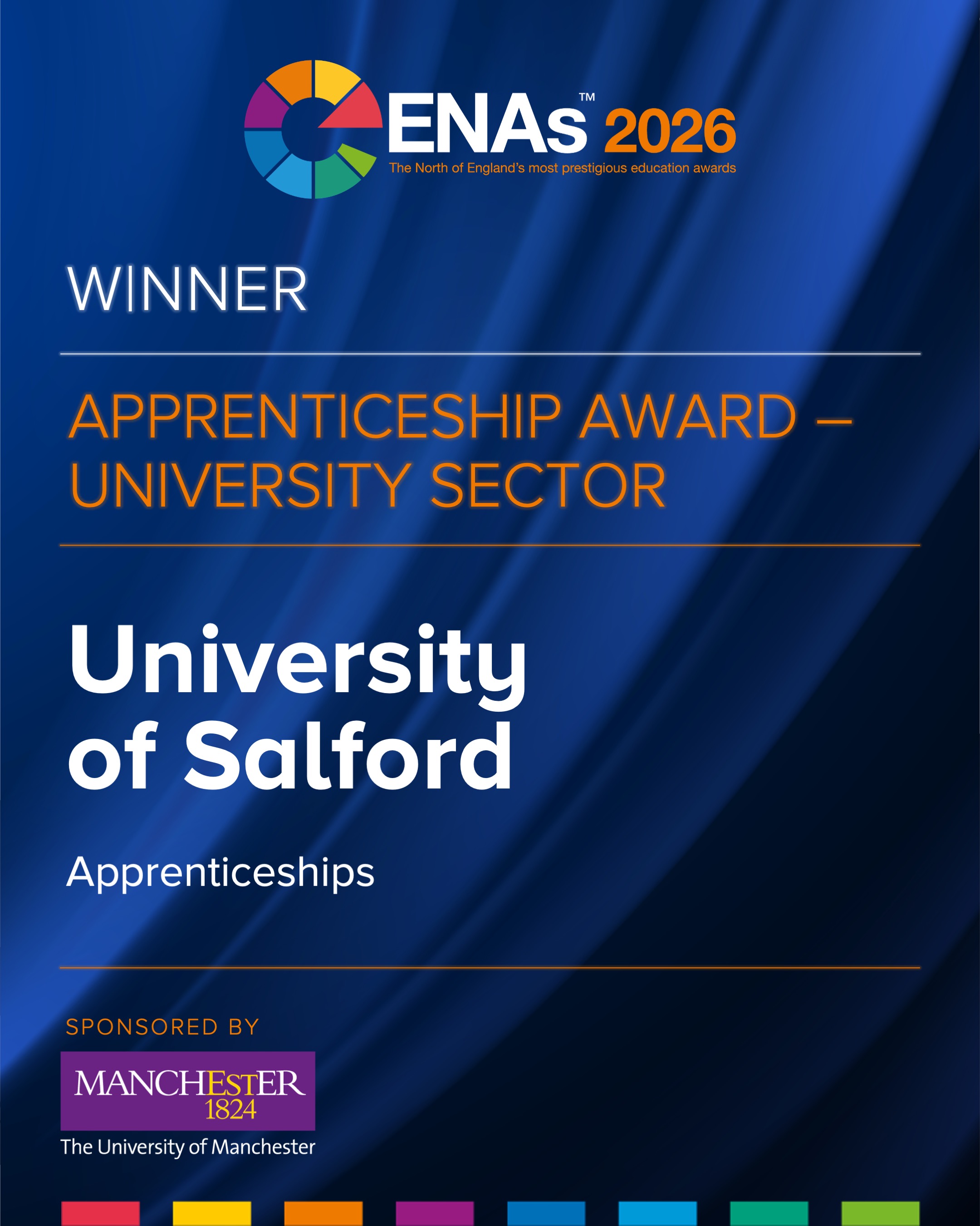
At the University of Salford, we're proud to have received the Apprenticeship Award at the Educate North Awards 2026, recognising our commitment to delivering career-focused education that makes a real impact across our region and beyond.
This achievement reflects the strength of our employer partnerships, the dedication of our colleagues, and the success of our apprentices as they develop the skills, knowledge and confidence to thrive in their industries.
Our Ofsted rating

In 2024, Ofsted inspected our apprenticeship provision and has confirmed our grading outcome as Good. This outcome is a testament to the hard work, commitment, and dedication of colleagues and employers in supporting our apprentices to develop substantial new knowledge, skills and behaviours, whilst having the best apprenticeship experience possible.
Amongst the findings, our strengths include:
- Highly qualified and experienced staff
- Individual Learning Model to plan personalised curriculums
- High-quality resources
- Collaborative working with employers.
Our programmes
We offer undergraduate and postgraduate apprenticeship programmes across a range of subject areas, including Construction, Engineering, Health, Science and Digital. Browse the list below for more details.
Our programmes
Construction and engineering
- Construction Site Supervisor | CertHE Construction Project Management
- Construction Quantity Surveying Technician | CertHE Quantity Surveying
- Construction Quantity Surveyor | BSc (Hons) Quantity Surveying
- Chartered Surveyor | BSc (Hons) Quantity Surveying
- Chartered Surveyor | BSc (Hons) Building Surveying
- Chartered Surveyor | BSc (Hons) Real Estate (Development and Management)
- Construction Project Management | BSc (Hons) Construction Project Management
- Civil Engineer | BEng (Hons) Civil Engineering
Health and Society
- Nursing Associate | FdSc Nursing Associate
- Registered Nurse | BSc (Hons) Nursing / RN Adult
- Physiotherapist | BSc (Hons) Physiotherapy
- Podiatrist | BSc (Hons) Podiatry
- Public Health Practitioner | BSc (Hons) Public Health Practitioner
- Occupational Therapy | BSc Occupational Therapist
- Graduate Certificate Enhanced Practice
- Advanced Clinical Practitioner | MSc Advanced Clinical Practitioner
- Specialist Community Public Health Nurse (SCPHN) | PgDip SCPHN - Health Visiting
- Specialist Community Public Health Nurse (SCPHN) | PgDip SCPHN - School Nursing
- Community Nurse Specialist Practitioner (CNSP)| PgDip CNSP - General Practice Nurse
- Community Nurse Specialist Practitioner (CNSP) | PgDip CNSP - Adult Social Care
- Community Nurse Specialist Practitioner (CNSP) | PgDip CNSP - District Nursing
- Community Nurse Specialist Practitioner (CNSP) | PgDip CNSP - Learning Disability Nursing
- Community Nurse Specialist Practitioner (CNSP) | PgDip CNSP - Children's Community Nursing
Artificial Intelligence (AI)
National Apprenticeship Week
National Apprenticeship Week is our opportunity to celebrate the achievements of Salford apprentices and the positive impact they are having on their communities, workplaces, and the wider economy. This year, we had a lot to celebrate as we've seen our apprenticeship provision continue to grow and develop, in part due to the over half a million pounds in funding we received from the Office for Students. Watch our video to see how we celebrated National Apprenticeship Week or visit our webpage to learn more.
FAQs
If you want to learn more about apprenticeships, take a look through our frequently asked questions. If you have a question that isn't answered here, please contact us using apprenticeships@salford.ac.uk
Information on safeguarding and our British values statement:
Choose your question
Who pays the apprentice's training costs?
Training costs are covered by levy funds in your digital account. Non-levy payers can receive 95% towards training costs from the Government via the co-investment model. Due to the nature of apprenticeships and how they are funded, apprentices will not be eligible for student finance - this includes tuition fee loans and maintenance loans.
Who recruits the apprentice?
As the employer, you are ultimately responsible for posting apprenticeship opportunities and deciding who you want for the position. We are also on hand to help with recruitment, ensuring you get the best person for the position.
Will the apprentice learn skills and knowledge that is relevant to my business?
Yes, you will be able to inform the course by working with us on the programme's design and delivery.
Who is eligible for an apprenticeship?
Anyone over the age of 16 can apply for an apprenticeship as long as they meet the relevant entry criteria for the apprenticeship.
What apprenticeships are available at the University of Salford?
We currently offer a range of higher and degree apprenticeships in construction, engineering, science health & society. Scroll up for more details on the programmes we offer and the courses we're developing. If you want to find out more about developing your workforce, please contact apprenticeships@salford.ac.uk
How much time will the apprentice spend at work and at university?
Apprentices spend 80% of their time in at work and 20% in university. We have a range of course delivery modes including day-release, block delivery and online learning. The mode of study will depend on the programme the apprentice is on.
How long do apprenticeships take to complete?
This is dependent upon the programme, but apprentices typically complete their degree within one to five years. Apprentices then have up to 12 months after graduation to complete their end-point assessment.
Who pays the apprentice's wage?
As the employer, you will pay the apprentice's wage, holiday pay, pension and any other benefits your employees receive. The funding you receive from the government (or the levy payments you choose to use) can only be used to cover training costs, not wages or any other benefits. Apprentices must be an employee on the first day of their apprenticeship.
Where can I get more information about apprenticeships?
To find out more about working with us, contact apprenticeships@salford.ac.uk , or visit the UK Governments further and higher education, skills and vocational training page.
English and Maths Requirements for Apprenticeships
Recent government reforms have introduced greater flexibility around English and maths requirements for apprentices aged 19 and over. Apprentices are no longer automatically required to achieve a standalone Level 2 English and/or Maths qualification to complete their apprenticeship where it is not considered necessary for their training plan. However, apprentices must still develop the English and maths skills required for their occupation.
As a university delivering degree-level apprenticeships, we consider a range of factors when assessing applicants, including:
Professional Body Requirements
Some professions and regulatory bodies may continue to require Level 2 English and/or Maths (or equivalent qualifications) as part of their standards or registration requirements.
Academic Entry Standards
Degree apprenticeships are academically demanding. In line with our admissions policies, we may require Level 2 English and Maths (or equivalent) to ensure apprentices have the skills needed to succeed in higher-level study.
Learner Success
Strong foundations in English and maths support apprentices in engaging effectively with academic study, assessments and workplace learning.
While employers play an important role in apprenticeship recruitment and development, the university remains responsible for setting appropriate entry requirements for its programmes to ensure apprentices are prepared for success.
For further guidance, contact the Apprenticeship Service Unit at apprenticeships@salford.ac.uk.
Application deadlines
Please be aware of the application deadlines below for each of our intakes. If an application hasn’t been received by this date, consideration will be given for the next available intake. Please be advised this is a deadline for a full application to be made. A request for services form will have to be completed prior to the application form being shared.
These dates allow us sufficient time to draw up and issue the employer evidence pack (contract etc.). Please also be aware that we will need to receive the completed employer evidence pack back prior to the apprentice starting the programme.
- January 2027 Intake - The application deadline is Friday 27 November 2026
- March 2027 Intake - The application deadline is Friday 20 March 2027
- April 2027 Intake - The application deadline is Friday 19 March 2027
- September 2027 Intake – The application deadline is Friday 31 July 2027