
Waste

Waste and recycling is one of the most visible areas in the sustainability agenda and can demonstrate our commitment to staff, students and visitors as well as offering an opportunity for people to easily get involved in environmental improvement.
Behind the scenes we are deeply committed to the development of sustainable waste management practices, as highlighted in our Environmental Sustainability Policy, and make it as easy as possible for the university community to engage with sustainable waste disposal.
Our progress so far
In the academic year 2025/26 we produced 435 tonnes of waste (excluding construction waste), which is down from 450 tonnes the previous year. We are now a zero to landfill university as our general waste is sent for energy recovery; this is where rubbish is burned, steam heats water which turns a turbine and energy is sent to the grid. This method is a better alternative to landfill as they do not produce methane, a potent greenhouse gas, however they do produce carbon dioxide so recycling is always the preferred method.
When we average our total waste to how many people are at our university, it means one person produces 17kg of waste at the university every year, which is a third of what it was ten years ago - a significant reduction especially when our student body has increased by 8000 over that time-period. An important change we made was reducing general waste skips from campus therefore it was harder to dump bulky waste and instead should separate it out into different waste streams. Our use of paper is also tracking significantly down as more things move to digital formats.
Our recycle rate for 2025/26 was 45%; we recycle as many materials as we can including paper, plastic, food, wood, metal, chemicals, plasterboard, books and electrical equipment. Food recycling is one of our newest projects and is really important as it is high in methane; we send your food waste off-site and it's turned into fertiliser and the methane is captured as biogas.
| Waste disposal method | Percentage (%) |
|---|---|
| Landfill | 0 |
| Incineration | 0.6 |
| Anaerobic digestion | 7.4 |
| Recycled | 37.6 |
| Energy from waste | 54.3 |
Waste management - is coordinated by the Sustainability Team and Estates and Facilities Division in accordance with the waste and recycling service level agreement. All members of staff in the Estates Division are trained on responsible waste management by the Environmental Sustainability Team and refreshed annually. Please contact us if you have any queries about the support we provide.
Construction waste - the amount of construction waste generated each year varies immensely depending on the campus development at the time, therefore a target for reduction of this is not achievable; however we encourage contractors to aim for at least 90% recycling.
Our Sustainable Waste Management Plan
The objectives of our Waste Management Plan are to:
- To ensure legal compliance and best practice with waste management
- Implement waste hierarchy principles - reduce, reuse & recycle
- Minimise avoidable single use plastics across campus
- Improve quality of waste data and sharing across the university
- Engage with the university body on waste and recycling initiatives
Our targets:
- Record no major non-conformances
- Reduce total quantity of waste by at least 25% from 2018/19
- Reduce the quantity of waste per staff and student FTE by at least 50% from 2018/19
- Divert at least 99% of waste from landfill
- Reuse at least 5 tonnes of furniture and stationery every year
- Increase overall recycling of University waste to 50% by September 2030
Please see the links at the bottom of the page for detailed information on each of our targets.
At the University we have a zero to landfill operation; instead, our waste is burnt to produce energy. Although this is a preferred method to landfill, it still has an impact on our planet, so we promote other waste management actions through our waste hierarchy
Our guiding principles
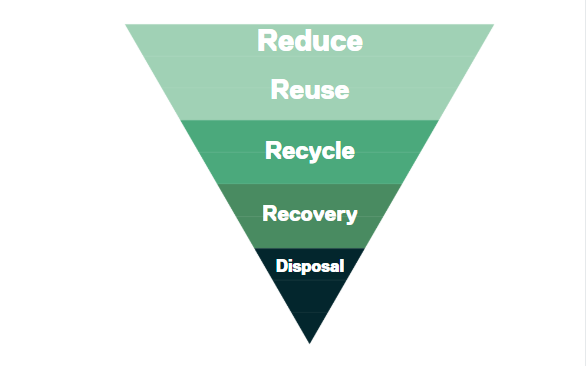
The waste hierarchy means we consider waste reduction and reuse before recycling and waste disposal. We apply life-cycle thinking during purchasing so furniture is durable and we actively work to use existing items when furnishing new areas. Furniture is also available for staff and they can browse our surplus assets through Warp It, our reuse portal. For more information go to our reuse page.