

BSc (Hons) Computer Science with Artificial Intelligence
- Course type
- Undergraduate
- Course qualification
- BSc (Hons)
Course summary
What is the fee?
For all course options, see fees and funding
Where will I study?
Peel Park campus
What is the UCAS code?
GG4R
How long will I study?
Full-time: Three years
With placement: Four years
International students accepted?
Yes, available to international students
Overview
We are living in an era where Computer Science is the backbone of innovations across every aspect of our lives, from communication systems to healthcare facilities. As the field continues to evolve, one of the most dynamic areas within the discipline is Artificial Intelligence (AI). AI is no longer science fiction but a reality that is revolutionising industries and changing our everyday life experience.
Over three years, or four if you choose to study a placement year, studying Computer Science with Artificial Intelligence will equip you with a deep understanding of both the core principles of computing and the intelligent technologies that are changing our future. Our BSc (Hons) Computer Science with Artificial Intelligence is a future-focused course that provides a solid foundation in core computer science while equipping you with cutting-edge AI skills.
We explain the power of machine learning, neural networks, computer vision, and natural language processing, all of which are grounded in a deep understanding of software engineering, algorithms, and data science. From the first year, you will gain hands-on programming experience in languages and develop a methodical approach to designing and implementing intelligent systems.
You will graduate with a blend of theoretical knowledge, practical expertise, and ethical awareness to build the AI solutions of tomorrow.
Start your study journey
Register for our next Open Day to learn more about studying computer science, explore our facilities and meet the course team
You will:
- Gain a strong grasp of object-oriented programming, algorithms, and data structures to prepare for complex AI applications
- Learn the principles of relational database management system, measuring their implementation and efficiency using emerging trends
- Learn foundational and advanced AI techniques, including supervised and unsupervised learning
- Explore natural language processing, deep learning, and neural networks with a thorough understanding of both capabilities and limitations
- Undertake a final-year project focused on developing an AI-driven solution for a real-world problem
This is for you if...
You want to gain cutting-edge computing and AI skills that are highly sought after by employers worldwide
You want to build a portfolio of AI projects that showcase your abilities to future employers
You want to learn from experts actively researching the latest computing and AI technologies and trends
Frequently asked questions
What is computer science with AI?
Computer science with AI is a field that combines the core principles of computer science with the study and application of artificial intelligence (AI). It equips students with the knowledge and skills to build intelligent systems, understand how AI works, and contribute to the development of AI-powered technologies. Essentially, it's a degree focused on both the fundamental building blocks of computing and the cutting-edge field of AI.
What jobs can you get with a computer science with AI degree?
- Machine Learning Engineer
- AI Engineer
- Deep Learning Engineer
- Data Scientist
- AI Product Analyst
- AI Consultant
- AI Product Manager
Is it worth doing computer science with AI?
Yes, a computer science degree with a specialisation in AI is generally considered a worthwhile pursuit due to the high demand and promising career prospects in the field. AI is rapidly growing and transforming various industries, creating a significant need for professionals with both strong computer science fundamentals and specialised AI knowledge.
Which field of AI is in demand?
AI skills are highly sought in various sectors, such as gaming, robotics, facial recognition software, military applications, speech and vision recognition, expert systems and search engines.
School of Science, Engineering and Environment

Rising to the challenge of a changing world, our degree courses are designed to shape the next generation of urbanists, scientists, engineers, consultants and leaders.
Driven by industry, and delivered by supportive programme teams, you can develop the computer science knowledge and skills to become unstoppable in your career.
Facilities

As a computer science student you will learn in our specialist computing suites and laboratories, including a networking laboratory and dedicated final year project laboratory. You can also use Cisco-enabled facilities with the option to gain Cisco Certified Network Associate status.
Industry Collaboration and Research

Industry Collaboration
When you start your computer science degree with Salford, you are also joining a community making a difference in industry, our local region and in our wider society.
Many of our academics and technicians who support your course also deliver collaborative, interdisciplinary, high-impact work in a range of local and global computing and informatics issues and challenges.
Advancing Greater Manchester
As a civic university at the heart of Greater Manchester, we are passionate about making our region a sustainable, inclusive, and progressive place for everyone. Our shift into a digital world is bringing new challenges to local businesses, many of whom lack the knowledge and infrastructure to sustain stability and growth. The GM Cyber Foundry and GM AI Foundry are two regional initiatives in which Salford is a partner providing support to help local and regional businesses based in Greater Manchester prepare for a digital future.
GM Cyber Foundry
Businesses face new challenges in the evolving shift to a digital world. The Greater Manchester Cyber Foundry is a programme designed to help SMEs with cyber challenges in business growth, stability, and security.
Find out more about the GM Cyber Foundry
GM AI Foundry
Artificial intelligence is revolutionising the operations of industries. This research and innovation project aims to support SMEs in Greater Manchester using Artificial Intelligence (AI) to enhance or develop new products and services.
Find out more about the GM AI Foundry
Research
Informatics Research Centre
Our Informatics Research Centre builds on the research history, success and achievements in computer science and information systems developed by Salford over the last four decades. Evolving around data and information of all types and usages, our Centre focuses on all phases and processes, from data pre-processing to engineering and visualisation.
The techniques and systems developed have a wide range of applications, including the digitisation of historical documents, medical diagnosis, semantic tagging, segmentation of types of viewers and their behaviours, text mining and retrieval, and data visualisation.
Data Science and Artificial Intelligence Hub
At the heart of innovation and discovery, the Data Science and Artificial Intelligence (DSAI) Hub at the University of Salford is a dynamic and collaborative community of experts, researchers, and enthusiasts dedicated to pushing the boundaries of data science and AI applications. Our diverse team, led by Professor Mo Saraee, brings together cutting-edge knowledge and experience to address the challenges of the digital age.
The DSAI Hub has one aim: to collaborate with industry, whether through bespoke training programmes, Knowledge Transfer Partnerships, or consultancy. We offer a diverse range of opportunities for industry professionals to actively contribute to and benefit from our wealth of expertise.
Discover how you are part of something bigger.
How you'll learn
Future careers

Employment
Once you complete the full honors Computer Science with Artificial Intelligence degree, you will graduate with exciting and rewarding career opportunities ahead of you. With demonstrable programming skills supported by a large portfolio of practical work, you will have a skillset applicable across many industries.
We are living in an exciting age in which visionary technologies are quickly becoming everyday technologies. Converging technology creates amazing opportunities for talented computer science professionals. The blend of unique skillsets you will acquire in computing and AI is in great demand in many different areas.
Many graduates choose to work as programmers and software developers, but others progress to other IT-based roles, including consultancy, system development, computer analysts, or AI engineers. Our computer science alumni have found employment with leading national companies across a range of industries, such as Sainsburys, Cisco, Microsoft, SIS, Autotrader, HMRC, Ferranti, and Civica, as well as local firms emerging in the fast-growing Northwest tech community.
Further study
You might find you want to learn more about Computer Science or Artificial Intelligence. Building on our expertise, we offer postgraduate courses in a range of fields that can take your interests and career opportunities further. Salford Computer Science graduates and alumni also receive a significant fees discount.
- Artificial Intelligence (MSc)
- Cyber Security, Threat Investigation and Forensics (MSc)
- Data Science (MSc)
- Internet of Things with Data Science (MSc)
- Software Engineering (MSc)
Modules
Course delivery
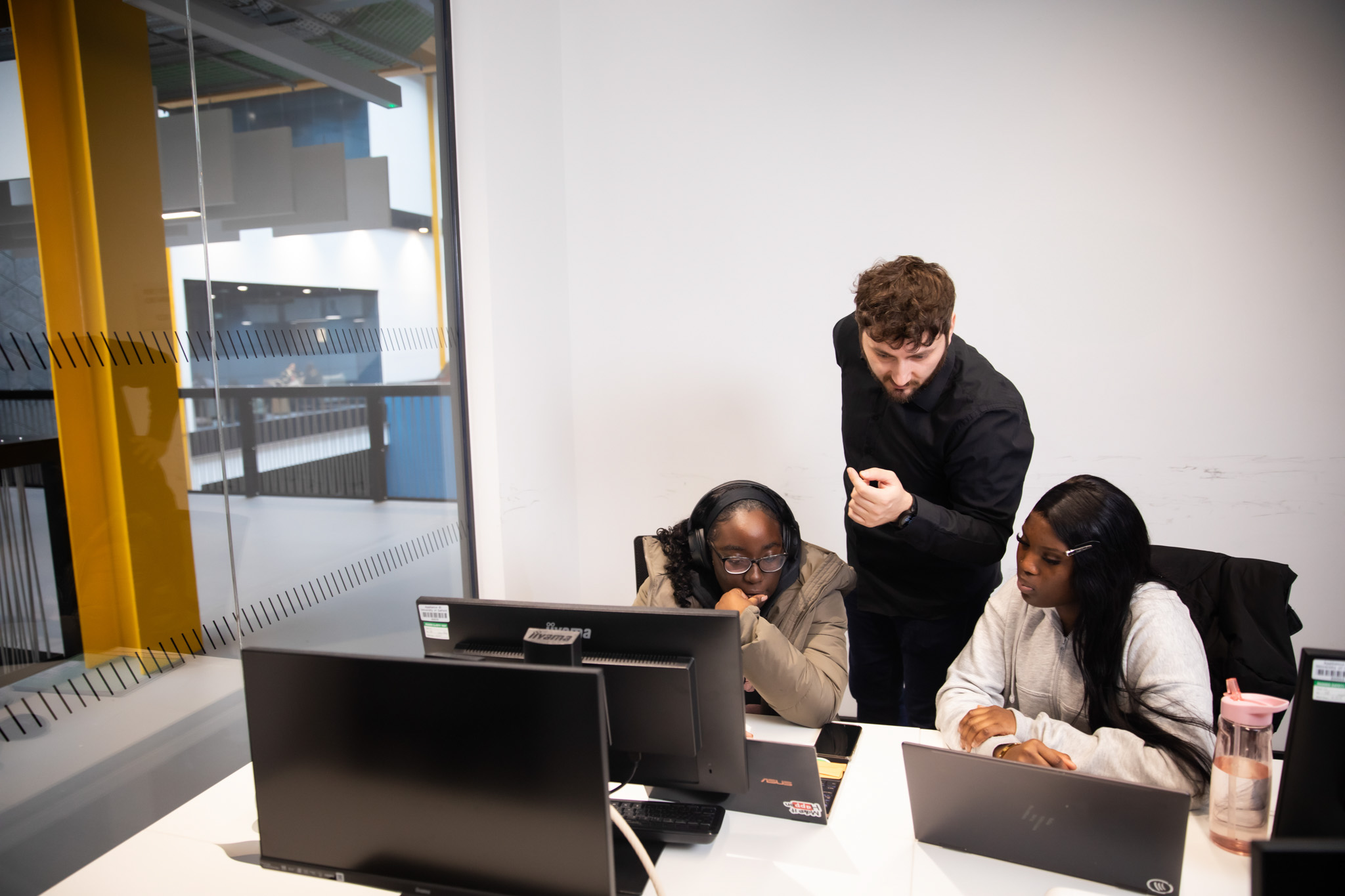
Delivered across three years (or four, if you choose to include an industry placement), our BSc (Hons) Computer Science degree with Artificial Intelligence is designed to develop your in-depth knowledge and understanding of programming, databases, computer systems, intelligent algorithms, and machine learning techniques.
Through core modules, you will learn about Java, Linux, databases, artificial intelligence, software engineering, deep learning, and natural language processing. You will also have the opportunity to choose optional specialist computer science and AI modules in web and mobile development, virtual reality, visual information analysis, big data analytics, and more.
Learn more about the course modules in the following section.
Learning experience
Embedding collaboration with industry and working on real-world projects is an essential aspect of studying Computer Science with AI at Salford. In your second year, you'll have the opportunity to take-part in our three-week long industry challenge, Hackcamp. Working in a team with other second year Computer Science students, you'll develop a web-hosted dashboard or application to meet a real-life brief, set by one of our industry partners. At the end of the three weeks students also have the chance to present their finished project at our Hackcamp showcase day.
Working on real-world set briefs alongside your specialist studies will give you the skills and knowledge you need to prepare for an exciting career in tech. You will also bring all of your learning together by completing an individual project in your final year, where you can focus on an area of Artificial Intelligence of your choice.
Industry placement
In this Computer Science with AI course, you will have the opportunity to take an industrial placement year between years two and three. Although you will be responsible for securing your own placement, we will assign you a placement tutor to monitor your progress and assess your final report.
By completing a placement year, you can add 'with professional experience' to your degree award. Industry placements are an excellent way to enhance your CV, gain hands-on work experience, and build industry connections.
Read about BSc Computer Science student Michal's industry placement year at local company Matillion.
Year one
Programming 1
You will be introduced to a practical, hands-on approach to programming where workshops will provide focused practical activity on a managed learning curve. You will learn excellent programming practice through design, implementation and testing, and will be introduced to the basics of structured programming language using an integrated programming environment.
Programming 2
You will strengthen your syntax and semantics base of Java developed in the ‘Programming 1’ module. You will develop an appreciation of recursion as well as your knowledge of dynamic data structures. Additionally, you will learn how to test and debug code, along with an appreciation of more sophisticated programming behaviour.
Database Systems
This module will share fundamental knowledge of database management systems, their design, implementation and applications. It will develop your knowledge and understanding of the underlying principles of relational database management system, and how to implement and maintain an efficient database system.
Professional Development and Practices
You will be introduced to the business context and application of computing and information systems. You will explore this through societal, professional, ethical and legal issues surrounding business practices and the theory and process of project delivery to a professional standard.
Web Development and Human Computer Interfaces
You will be introduced to theory and practice of website design and development and develop knowledge and understanding of human-computer interaction and techniques for designing and analysing user interfaces. You will also gain skills and practical experience of designing, developing and testing websites using HTML5 & Cascading Sheets (CSS).
Computer System Internals and Linux
This module will provide you with an in-depth low-level knowledge of computer systems, concentrating on computer architecture, operating systems and communications technology. You will also start to develop skills in the use of Unix-like operating systems at command-line level, writing and using simple scripts and batch files and the simple system administration of a standalone Linux PC.
Year two
Data Structures and Algorithms
In this module you will be introduced to some of the most important data structures used in the design and implementation of computer software and shown how these are implemented using Java. You will then learn to analyse the requirements of algorithm resources to allow you to provide a sound basis for objective choice when dealing with competing algorithms.
Design Patterns
You will receive a broad overview of software development methods and techniques, focusing on various modelling and design approaches. You will develop understanding of the application of generic pattern-based strategies for resolving common high-level problems in object orientated design. You will develop problem recognition and categorisation and learn how (and when) established pattern-based solutions can be identified and applied as solutions.
Career Development
You will develop a range of employability 'soft skills' to give you an advantage when applying for (and carrying out) a placement as well as graduate roles. Employers value a combination of technical and interpersonal skills. This module will draw from our extensive industry contacts to demonstrate the range of skills needed to succeed in your career and to help you develop a career plan.
Software Project with Agile Techniques (Salford HackCamp)
This module combines technical work in computer programming with personal-development planning. You will work in a group to design, develop, document, and demonstrate a solution to a problem, working to a professional standard using Java programming. This module also introduces agile techniques and methodologies and provides an opportunity to apply, evaluate, and reflect on these techniques.
AI & Data Mining
You will be introduced to Artificial Intelligence (AI) and Data Mining (DM) techniques for problem solving. You will become familiar with AI techniques and terminology for knowledge representation and searching, and gain an understanding of DM algorithms, and learn how these techniques are used in real world applications.
Client Server Systems
You will develop data-driven interactive web applications, with client-side and server-side components, using industry-standard software development tools and techniques. You will design, create, test and demonstrate software implementing a data-driven web application, programming, industry standard scripting languages (such as PHP and Javascript), connecting to industry standard databases, identifying security risks, and working within legal constraints such as data protection, accessibility and copyright.
Machine Learning
This module covers fundamental and advanced machine learning techniques, enabling the development of models that learn from data and improve over time. You will explore supervised and unsupervised learning, classification, regression, and clustering algorithms, equipping you with the skills to build intelligent systems that can make predictions and support decision-making in various domains.
Year three
Project for Computer Science (Artificial Intelligence Focused)
You will undertake an individual project that demonstrates your understanding of AI methods. You can select your own area of study, identify and develop realistic problems, and, working independently and in a professional manner, organise, sustain, and report on your project in a way which is both detailed and reflective.
Deep Learning
Introducing the field of deep learning and its applications, you will learn about the deep learning architectures and algorithms that are used in applications such as face recognition, speech recognition, and medical diagnosis. You will also have the opportunity to develop your professional skills using the Python programming language and a deep learning framework to develop predictive models and applications.
Natural Language Processing
In this module, you will learn how to enable machines to understand, interpret, and generate human languages. The topics include text processing, language modelling, sentiment analysis, and speech recognition. Through practical projects, you will gain hands-on experience in building applications such as chatbots, translators, and voice assistants, enhancing your ability to work with complex language data.
Optional modules - Group A (choose one):
Big Data Analytics and Internet of Things
This module explores the collection, storage, and analysis of large-scale data generated by connected devices and sensors. You will learn to use modern big data technologies and IoT frameworks to process streaming data, extract meaningful insights, and design scalable solutions for real-world applications in smart cities, healthcare, and industry automation.
Visual Information Analytics
Visual Information Analysis (VIA) is a key component of several real-world applications in the fields of Computer Vision, Artificial Intelligence, Machine Learning, and Big Data analytics. For example, Manufacturing and Production, Retail, Surveillance and Security, Autonomous Vehicles and Transportation, social media and Entertainment, Healthcare, Agriculture, and Inspecting Power Lines with Drones.
When capturing images using mobile cameras, drone cameras, and CCTV cameras, Visual Information Analysis is essential to understand the content of the images. Therefore, this module focuses mainly on how to formulate an image, represent the image, extract features, and visualise the content in the image for prediction and decision-making.
Optional modules - Group B (choose one):
Virtual Reality and 3D Games
This module provides a comprehensive understanding of the principles, practices, and measures of virtual reality technology and the development of interactive 3D worlds. Applications of the technology that will be used are from across sectors, including the computer games industry, medicine, energy, engineering, and science. You will develop your programming to an advanced level of understanding and experience in modern interactive 3D engine development.
Business Management
This module aims to provide students with business and enterprise concepts to allow them to analyse and evaluate business practices, concepts, theories, and frameworks and their relationship to the strategic and operational management of an enterprise or a project. This is intended to complement the technical project management content of the course and provide a real-world context linked to current enterprise activities at the university itself. You will also learn about freelancing.
Mobile Development
The module provides an introduction to the key technologies used to provide interactive websites and applications for use with mobile devices, taking into account the unique environment in which these applications operate. Consideration will be given to how these technologies can be used while still maintaining web standards, particularly accessibility.
Advanced Web Development
You will learn about the common stages of creating a large-scale web application. This consists of the following: development of a scalable web application using design patterns, frameworks, and other industry best practices; discussion of the concepts of APIs; designing a fully RESTful API for the application; and creating a client to consume the application API.
We take a flexible approach to our course delivery that promotes diversity and inclusivity and provides a blended learning experience, which will vary to meet specific programme requirements. This learning time includes formal lectures and interactive activities such as seminars, tutorials, practical sessions, laboratory and studio learning. Smaller classes may be used to support collaborative activities such as project and group work and presentations. A range of different assessments and feedback is offered to meet the needs of both our diverse student body and specific subject needs.
Our undergraduate courses are normally made up of 20 credit modules which are equal to 200 hours of learning time. A three-year degree qualification typically comprises a total of 360 credits (120 credits per year).
Please note that exact modules and content offered may vary in order to keep content current and, for courses that offer optional modules, may depend on the number of students selecting particular options. When accepting your offer of a place to study on a programme with optional modules, you should be aware that optional modules may not all run each year. Your tutor will be able to advise you as to the available options on or before the start of the programme. Whilst the University tries to ensure that you can undertake your preferred options, it cannot guarantee this.
Entry requirements
Applicant profile
We are looking for applicants with a strong interest in computing, a good work ethic, and attention to detail. You will have an interest in understanding how computers work rather than just wanting to be a user of them. With such exciting opportunities emerging in computer science, we are seeking applicants who have the initiative to take their learning beyond the tasks that are part of the coursework.
English language requirements
If you are an international student and not from a majority English speaking country, you will need an IELTS score of 6.0 with no element below 5.5. We also accept a range of other English language qualifications. If you do not have the English language requirements, you could take the Pre-Sessional English course, or the International Foundation Year to gain entry onto this degree.
Standard entry requirements
GCSE
In addition to the following Level 3 requirements, you must have evidence of Level 2 GCSE English and Maths at Grade C/4 or above.
UCAS Tariff points
112 UCAS Tariff points.
A-level
Two full A-levels required as a minimum. Must include grade C in Computer Science, Computer Studies, IT, ICT, Maths or a numerate science.
BTEC National Extended Diploma
DMM from Computing, Maths, IT related subject or a numerate science.
T Level
Overall grade M in Digital Production, Design and Development or Digital Support Services. Must have passed all components.
International students
We accept qualifications from all around the world. Find your country to see a full list of entry requirements.
Alternative entry requirements
Salford Alternative Entry Scheme (SAES)
We positively welcome applications from students who may not meet the stated entry criteria but who can demonstrate their ability to pursue the course successfully. Once we receive your application, we'll assess it and recommend it for SAES if you are an eligible candidate.
There are two different routes through the Salford Alternative Entry Scheme and applicants will be directed to the one appropriate for their course. Assessment will either be through a review of prior learning or through a formal test.
Not sure how many UCAS points you have? Use our UCAS Tariff Calculator to find out.
Fees and funding
See fees below
2027/28
| Type of study | Fees |
|---|---|
| Full-time | £10,050 per year |
| Part-time | Part time fee will be calculated on a pro rata basis |
2027/28
| Type of study | Fees |
|---|---|
| Full-time | £18,600 per year |
The tuition fees shown are for the first year only. If your course lasts longer than one year, fees may increase each year in line with inflation, up to the maximum limits set by the UK Government.
Additional costs
You should consider further costs which may include books, stationery, printing, binding and general subsistence on trips and visits.
Scholarships for international students
If you are a high-achieving international student, you may be eligible for one of our scholarships to study computer science. Explore our international scholarships.
How to apply
Enrolment dates
Student information
Terms and conditionsUCAS information
Course ID GG4R
Institution S03