Jessie's Prosthetics and Orthotics story
What inspired you to study Prosthetics and Orthotics (P&O)?
I have always been interested in the human body, how it moves and allows us to do the things we want/need it to. I also really enjoy mechanics and design. The field of Prosthetics and Orthotics is a good combination of both. P&O is about working with people practically, whilst making things and designing prescriptions based on patient need.
What does a typical week look like for you—balancing placement and university life?
In year 1 and 2 there is a week of placements – a full week block in year 1 and 5 individual days spread throughout year 2. So balancing that with university life is pretty straightforward. When I was not on placement, I was kept busy with lectures and practicals. I was on campus 3, sometimes 4, full days a week for the whole trimester. Thanks to the NHS grant and living at home, I was lucky enough to not need to work alongside my studies. I do know, however, that some people in my class have managed to balance studies and work part time jobs in a bar or shop.
Year 3, is made up of 2 x 13 week placements with one for Prosthetics and the other for Orthotics. During those times, there is no other university work to do so I am able to focus fully on placement which is mostly learning by doing and working with practical patients. There is some paperwork which needs to be done by the end of placement but it is very manageable if you chip away at it throughout the 13 weeks.
What has been your most memorable moment on the course so far?
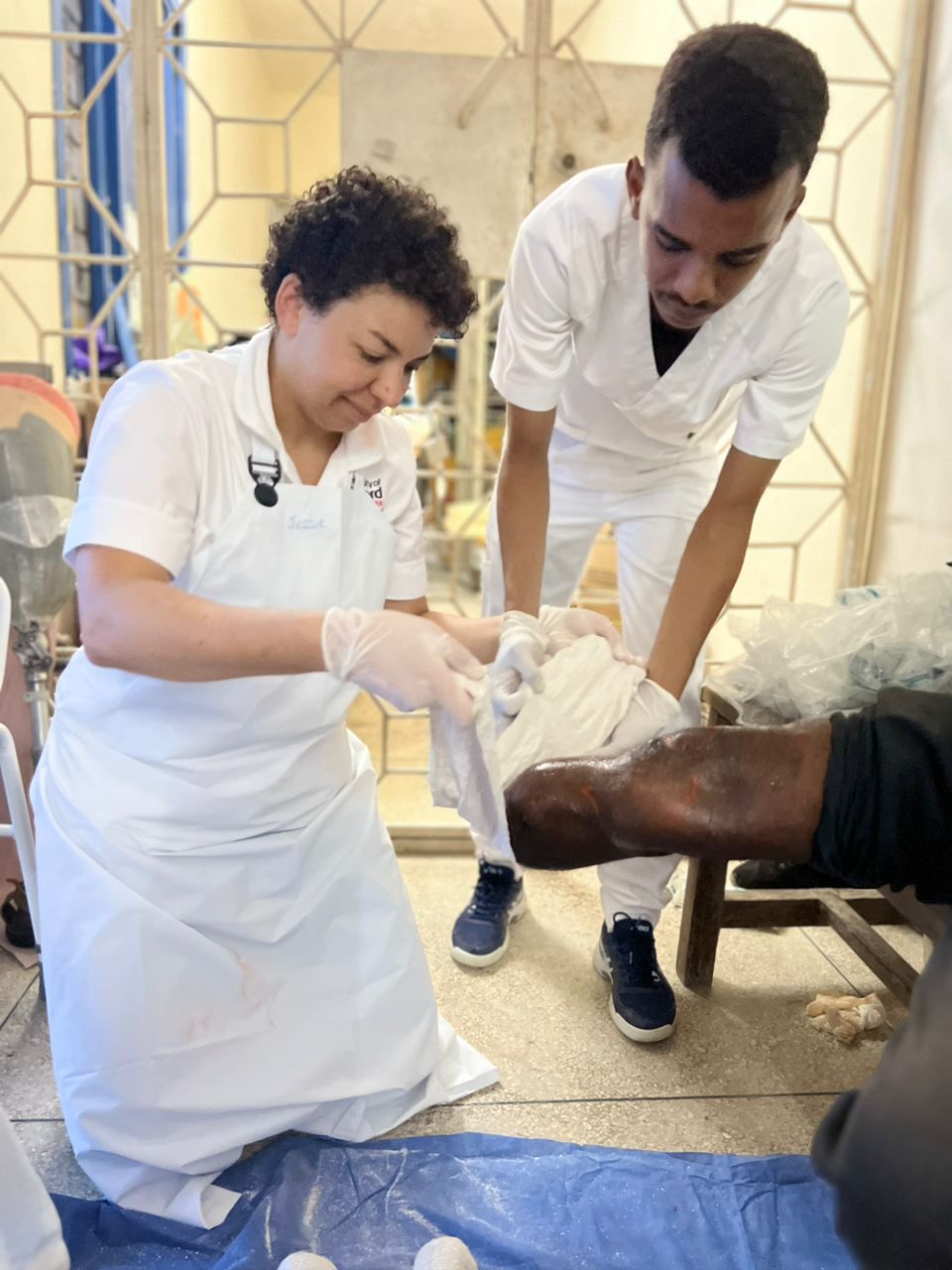
My most memorable moment on the course so far has been a project we did alongside our formal upper limb prosthetic module. The project was to help make prosthetic hands for some patients in Uganda who had lost their arms above the elbow through traumatic circumstances. Being involved with this project provided a good opportunity to apply my theoretical and practical skills to a real life situation which would actually make a difference to someone’s life. Although the team didn’t get to meet the patients in person, we were able to do a Zoom call when the patients came to the clinic for fitting. It was so rewarding to see the look on the patients face when they had the finished arm on and realised that people might not stare at them as much anymore since it was not as obvious they were missing one arm. The excitement for the patients when they realised that they would be able to hold things in two hands again was so gratifying. The whole experience reminded me why I wanted to do this course in the first place, and gave me a taste of the difference I can make to people’s lives in the future.
How do you feel this course prepares you for future roles within healthcare?
The course at the University of Salford is well-rounded and the modules cover a vast range of topics. This theoretical foundation, together with the extensive practical components provides the knowledge and basic skills to get me started in healthcare and allow me to further develop as a clinician in the field.
The course provides a base for us to build on during placements and early career. With the variety amongst patients and conditions, there will likely be things that we see every now and then which we don’t already know about. The course also helps develop problem solving and critical thinking skills to allow us to deal with anything which comes into our clinic room – even if we have never seen it before.
What advice would you give to someone considering applying to this programme?
DO IT! I think this is the kind of course which not many people know about and, even if they do know about it, it will not be everyone’s cup of tea. So if you think this is something you might enjoy, you probably will! Since I’ve been on placement and seeing patients in real life, it has confirmed that this is such a rewarding profession. The difference can often be seen/felt immediately and the patients are often very grateful for the help.
I would say you need to be committed to doing the course though as it is busy, but the effort put in is worth it and I have thoroughly enjoyed the lecture content, practical sessions and placements.
Can you tell us a bit about what you are hoping to achieve after your degree?
Once I’ve qualified, I would like to work in both Prosthetic and Orthotic clinics as I really enjoy both disciplines. Although this is not common, as people most often choose one or the other, there are some jobs around which are dual practice so I’m hoping to secure one of those. One day I may end up back at Salford or one of the other universities which now offer the course, either lecturing and/or doing research. I understand the importance of providing evidence and data to support our practice, as well as continuously looking for and developing the best options for our patients. Additionally, I enjoy being able to share knowledge and experience to support other people to join the field and help patients.