
Salford researchers aid in development of myoelectric hand

A team at the University of Salford have contributed to the development of the ‘Bionicohand’, a new, ‘highly repairable’, open-source, myoelectric hand.
The concept for the hand was invented by Nico Huchet, a prosthesis user himself, alongside a team of developers in France, to challenge how we currently design and deliver prosthetics. Nico’s approach to the project is exemplified in his MyHumanKit Fabrication Laboratory (FabLab), which aims to support people with disabilities to work with engineers and others to co-design and make products suitable for their needs.
Modern prosthetic hands can cost tens of thousands of pounds, but do not meet everyone’s needs - some users have reported that they can be easily damaged, and their control can be challenging. The weight of these models also tends to be an issue, due in part to their complexity.
Nico’s device is simpler than standard designs, yet still offers a good level of function. The design means that simple repairs could be carried out more easily, potentially even by users themselves. This may reduce the need to send devices back to the manufacturer for repair and improve the lifespan of the product.
Nico’s vision is to make the hand available ‘open-source’, meaning the design is freely available online and can be downloaded and made locally.
Nico said, “With myoelectric hands, to me it is like autonomous cars – we think it is going to be better, but in fact, we have a lot of problems as well.
“I was obsessed with this new hand that I couldn’t have, but I discovered the Fab Labs (fabrication laboratories), and it was interesting to learn to use the 3D printer, by making a hand for me.
“On the internet, I discovered the open-source world where you have access to open-source 3D files for free that you can download and 3D print directly in the FabLabs, and that was a revolution to me.”
In order to make Nico’s hopes of an open-source hand a possibility, he had to ensure that the hand could be recreated by a team external to the developers who had initially created it in France.
Nico’s Bionicohand team came second at the Cybathlon event in 2024, an assistive technology showcase and competition, in which University of Salford’s Visiting Professor Peter Kyberd was on the judging panel. Peter then invited Nico to a conference where he met Salford PhD student Leslie Davidson, whose work focuses on the repair and maintenance of prosthetics and the impact on users. It was this connection that led Nico to visit Salford, where he met Professor Laurence Kenney.
“Nico came over and visited us about a year ago,” Laurence said.
“We talked about the project, and at that point the hand had only been manufactured within their team in France, and we thought the next logical step, to test out the potential for the hand to be genuinely open-sourced, is to try making the hand in another lab.
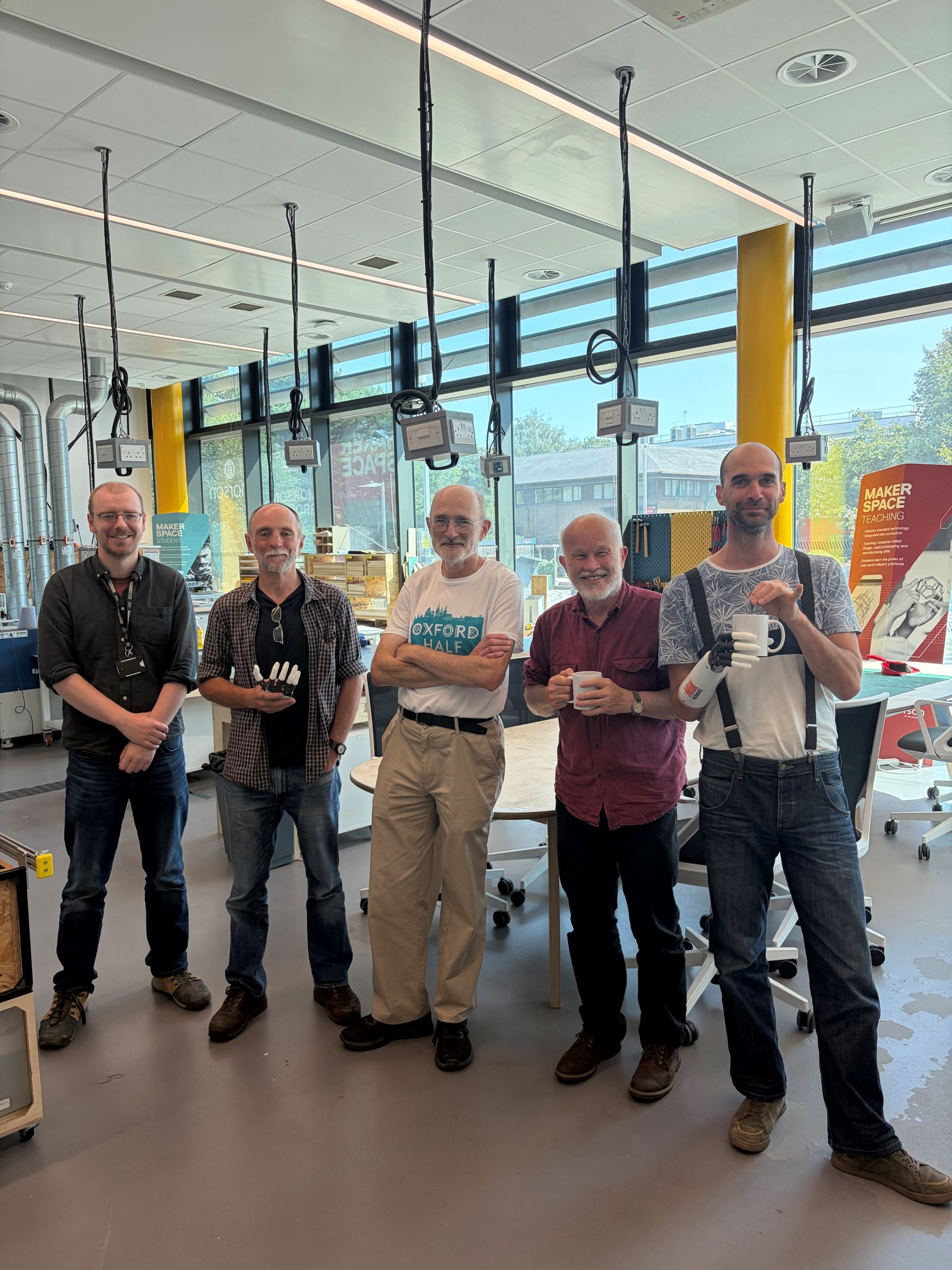
“We talked to the team in MakerSpace, and we had some funding through our Research Impact fund to employ Mick Prince, our fantastic design engineer colleague, and he worked with Aidan Dunbar (MakerSpace lead technician)’s team over here to test how difficult it is to actually make the hand from the available design information.”
“The work at Salford has identified a number of improvements that would make the design easier to manufacture,” Laurence said.
“A short-term goal for the French team is to implement some of the feedback that we have given them, who can then release the new version of the design with better guidance for future teams who want to make the hand.
“The next stage would be hoping that other universities will engage with the project, and try to repeat what we’ve done in Salford, to improve the design and the ease with which it can be manufactured.
Nico added, “We would like to create a community dedicated to upper limb amputation.
“Most amputees are lower-limb, so we need a site dedicated for upper-limb people, and to make connections between users, clinicians and universities very simple.
“If the University of Chicago wants to make the hand; they can contact Salford and can quickly exchange tips.
“If an amputee in Manchester is interested in weightlifting, and an amputee in the South of France is doing that, he can contact him through this site.
“We really want to build a community.”
Image Caption (L to R) : Aidan Dunbar, Mick Prince, Professor Peter Kyberd, Professor Laurence Kenney, Nico Huchet
For all press office enquiries please email communications@salford.ac.uk.