
Salford PhD graduate shares thesis ahead of council implementation

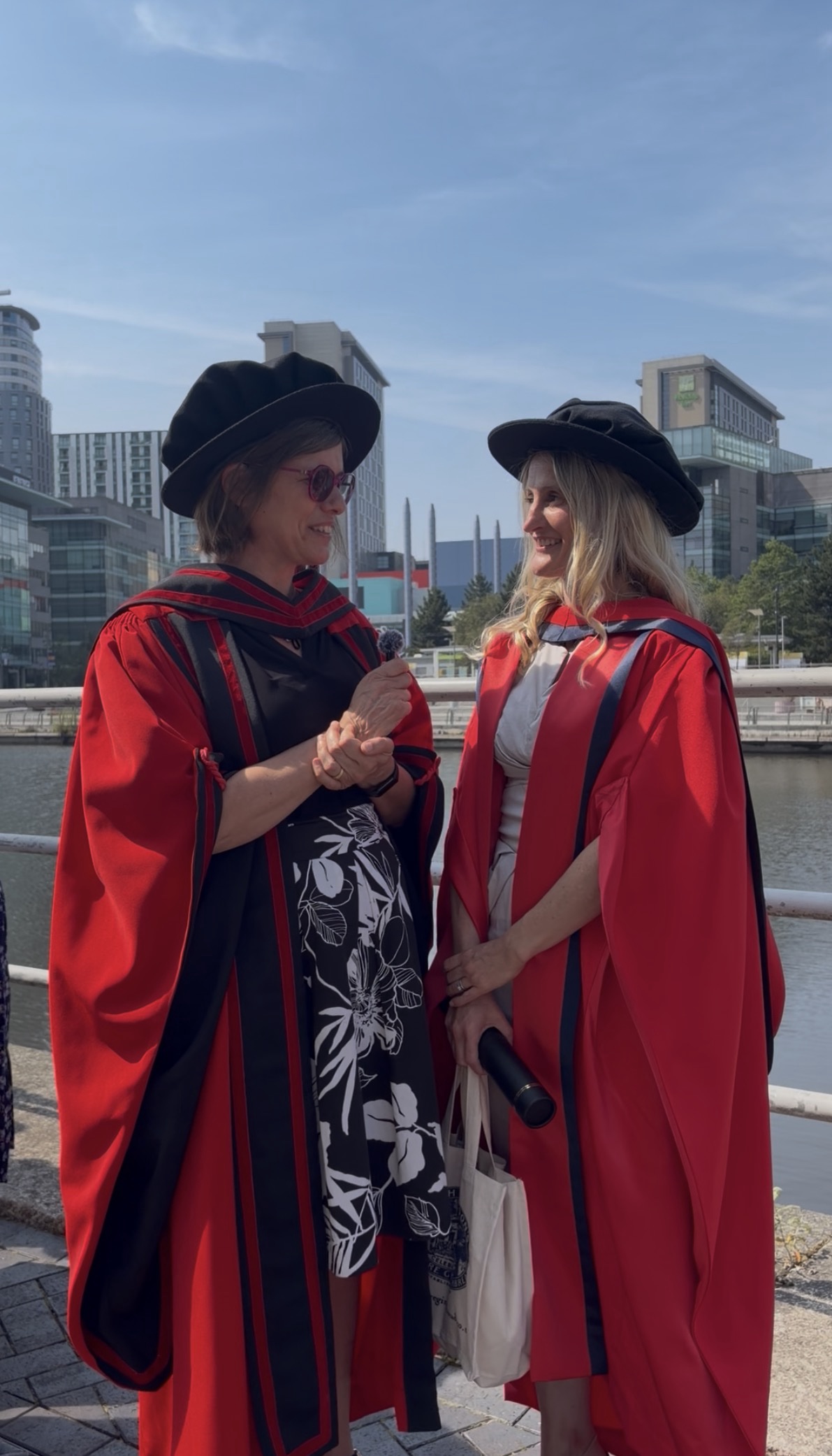
A Salford PhD graduate has shared her thesis as her work is set to be implemented into schools and local councils.
Bryony O’Connor, whose background is in public health, was inspired by the action seen in the Covid-19 response, in which bespoke, effective solutions were created by and for the communities.
She decided to research the ways in which communities can use this kind of action to fight another threat to public health – the climate change emergency – emphasising on food waste. With 10% of greenhouse gas emissions resulting from food waste, and 60% of those emissions coming from households, alongside the cost-of-living crisis, Bryony working with the co-researchers, community leaders and their groups, designed the initiative, ‘Save Money, Save the Planet’, to encourage households and their communities to reduce their food waste, and help them save money in the process.
After undertaking research on both low-income and affluent areas of the community, and designing tools to support food waste reduction, Bryony and the co-researchers also developed a Food Waste Toolkit for use in local community services.
The research was funded by the National Institute for Health and Care Research (NIHR) through its Local Authority Doctoral Fellowship Scheme. Bryony was the only Public Health fellow selected in the scheme’s first cohort.
Being a local authority practitioner conducting research in a local authority brought a multitude of opportunities and challenges. For example, while being able to build upon extensive networks was a positive, there were challenges in navigating local authority governance in an organisation without much research experience, along with university ethical approvals.
Bryony's role as an embedded researcher supported the recruitment of four co-researchers, 14 community leaders, 18 groups and 130 households. The research was highly participatory across all stages, with co-researchers as equal partners, and the community voices were pivotal in developing community tools and interventions.
Bryony said, “The work has an ongoing impact, with the development of the Food Waste Toolkit, which is being embedded in local practice, for example, in the Bolton Community and Voluntary Services (CVS) Eco Toolkit, Waste Management Services, NHS Green Champions, and Corporate Induction.
“Moreover, as the co-researchers feel genuine ownership of the toolkit, they continue to promote it by adapting its use in schools, supporting Middlesbrough Council to adopt it, and sharing it with the Department of Environment, Food and Rural Affairs (DEFRA).
“An important part of my journey has been supporting future researchers.” Bryony said.
“I have mentored other NIHR Doctoral Fellowship applicants and served as a Postgraduate Research (PGR) Representative, hosting support sessions and creating the PGR WhatsApp group of over 280 members, providing vital support and advice to students.
“In my research practitioner role, I helped build research capacity in the local authority by supporting the development of a research governance framework and delivering research skills training.
“I have also delivered lectures and seminars for the Public Health MSc/BSc on Commissioning and Co-Creation, sharing my practice-based experience.”
Professor Penny Cook, Associate Dean Research and Innovation, said, “Bryony has demonstrated exceptional achievement, leadership and resilience throughout her doctoral journey.
“She broke new ground as the first ever Public Health professional NIHR Local Authority Doctoral Fellow and was required to work part-time in the council alongside the full-time PhD.
“She delivered an ambitious and highly participatory programme of research within the complex environment of local government.
“Examiners described the thesis as both ‘brave and novel’, commenting on the ‘phenomenal amount of work’ undertaken, exceeding that seen in many PhDs, and commended the sophisticated handling of the ethical and methodological complexities of participatory research, recognising that she approached ‘ethics as a practice not a process’ throughout the study.”
When asked if she had any advice for current or prospective PhD students, Bryony said, “Get comfortable with the unknown, and the messy!
“Don’t be fazed by the end product of a PhD that looks all polished – it's presented in that way, but really it is very messy – and that is the reality!
“At some point you will emerge from that messiness, and it’ll all be worth it.”
Picture Caption: L to R, Professor Penny Cook, Bryony O'Connor
For all press office enquiries please email communications@salford.ac.uk.