
GCHQ and Greater Manchester universities launch major new human-AI research centre

Leading researchers will explore how humans and artificial intelligence can work together, helping shape the future of work and national security.
GCHQ - the UK's intelligence, security and cyber agency - is establishing a major new research initiative to explore how humans and AI can work together, bringing together expertise from three universities across Greater Manchester.
As AI becomes increasingly embedded in the workplace, understanding how people interact with these technologies - and where human judgement remains essential - is becoming ever more important.
The Centre for Human-AI Research and Technology (CHART) will unite researchers from The University of Manchester, Manchester Metropolitan University and the University of Salford to investigate how the UK government can adopt AI responsibly and at pace, while keeping people at the heart of decision-making.
The multidisciplinary initiative will combine expertise in technology with research in the social and behavioural sciences to rethink the future of work and understand how people can work effectively alongside increasingly sophisticated AI systems.
Where opportunities arise, CHART will work with industry to translate this research into practical capabilities that can be used across both civilian and national security settings.
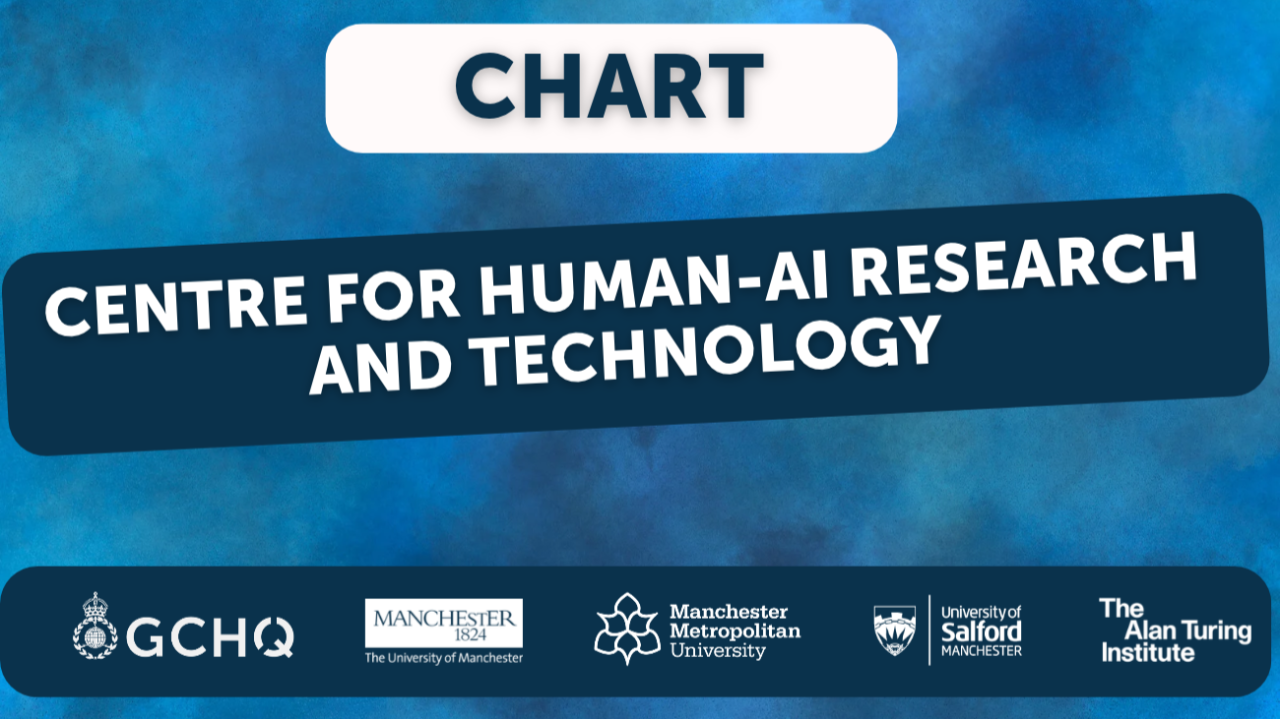
The partnership brings together three of the North-West's leading universities, alongside national research partners including the Alan Turing Institute. It will draw on the region's growing research and innovation ecosystem, helping to coordinate cutting-edge work on human-AI collaboration and strengthen the North-West's position as a centre for research and innovation in this rapidly developing field.
With the Government placing increasing emphasis on regional growth and the development of the UK's research and technology capabilities beyond London and the South-East, CHART will provide a focal point for collaboration across Greater Manchester and the wider North-West.
Professor Danielle George CBE, Chief Scientific Adviser National Security, said: “I’m thrilled to be able to share this new research initiative, and delighted it is being delivered in collaboration with universities in Greater Manchester, where I am proud to have spent much of my career.
“AI has a crucial role in national security, so it’s essential that teams like those in CHART work to understand how adoption and effectiveness can be coupled with a human-centred approach. As AI accelerates, we need people who understand the nuances of how they work, where they don’t, and how they can be used to our advantage. I look forward to following the CHART journey in this important work.”
Based on engagement across the national security community, CHART has identified five initial research priorities:
- Trust in AI: Understanding what trust means in an intelligence context, and how to mitigate the risks of placing either too much or too little trust in AI systems.
- Making AI understandable: Developing approaches to improve the interpretability and explainability of AI outputs, helping people understand and have confidence in the information they receive.
- Shared understanding: Exploring how AI can better understand human goals and context, provide useful recommendations and adapt as those goals and circumstances change.
- Human control and accountability: Identifying where AI can deliver the greatest benefits, where humans need to retain control and how accountability should be maintained.
- Supporting the workforce: Understanding the impact of working extensively with human-like AI tools, including how to prevent the erosion of critical thinking skills and the loss of expertise over time.
As the future of work increasingly involves teams made up of multiple people and AI agents, critical thinking and problem-solving skills are expected to become even more important.
The research will help identify the support and capabilities needed by the national security community to ensure it is prepared to meet future challenges in protecting the UK.
Professor Simon Green, Pro Vice-Chancellor Research and Knowledge Exchange at the University of Salford, said: "Universities have a vital role to play in driving the partnerships needed to address complex global challenges, and AI is no exception. This collaboration brings together outstanding research expertise from across the North-West along with key partners, creating a powerful platform for advancing our understanding of how people and AI can work together effectively and responsibly.
"By building on the region's thriving research and innovation ecosystem, we are strengthening the North-West's position as a leading hub for AI expertise.”
Professor Sunil Vadera, Professor of Computer Science at the University of Salford, said: "AI is transforming the way we live and work, but unlocking its full potential requires collaboration across disciplines, sectors and institutions. At Salford, we're already contributing to AI research and policy in a variety of ways, with expertise across the University exploring both the opportunities and challenges the technology presents.
"By joining forces with leading universities and partners through CHART, we can continue to build on that foundation, tackle complex questions around human-AI collaboration, and help ensure the North-West remains at the forefront of responsible AI innovation."
The launch of CHART represents a significant new collaboration between government and universities, positioning Greater Manchester and the wider North-West at the forefront of research into how humans and AI can work together.
For all press office enquiries please email communications@salford.ac.uk.