
An extensive collection of photographs relating to the history the University of Salford.
An overview
The photographs provide a visual record of the institution’s complex history. Themes include:
- buildings
- royal visits
- honorary graduates
- staff and students.
Many of photographs featured in official institutional publications such as the Vice Chancellor's Annual Report. Early photographs show:
- facilities
- workshops
- laboratories
- a costume drawing class featuring L. S. Lowry.
Royal visit
Prince Philip on campus in 1971.
Chemistry Tower
The implausible Chemistry Tower in the 1980s. It was demolished in the early 1990s.
A stitch in time
A sewing class at the Royal Technical College in the 1930s.
The photographs show how the physical campus changed and developed, particularly in the 1960s and 1970s. This was at a time when tertiary education was expanding.
Images show the construction of the Maxwell Building, designed for the newly established Royal College of Advanced Technology in 1957. This was followed by several buildings in the 1960s, including:
Images of architect's models are a useful insight for the wider Masterplan and strategic vision for the University campus during the 1970s. The image of the Paternoster Lift in the now demolished Chemistry Tower shows the value of photography to capture aspects of the past that no longer exist.
There are several images of the University's First Chancellor, HRH Prince Philip, the Duke of Edinburgh. He's shown visiting the institution over several years.
Images showing the visit of the Queen to the Royal College of Advanced Technology in 1961 are also included.
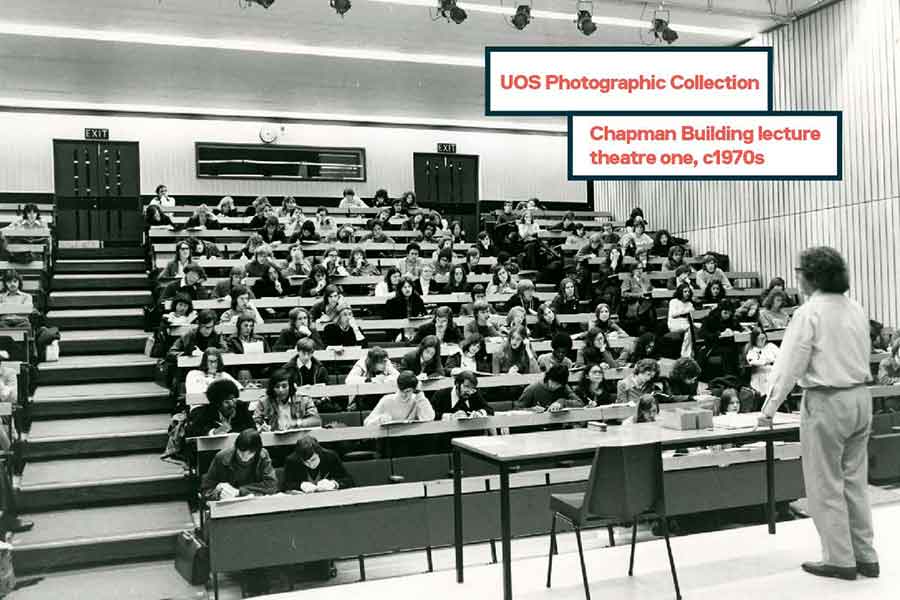
The photographs provide an insight into student life. Images include:
- Castle Irwell Student Village
- Freshers' Fairs
- Rag Day
- student demonstrations.
- Christmas socials
- staff and student sports teams.
The collection features many of the University's honorary graduates. These include:
- the artist L. S. Lowry
- the cellist Jacqueline du Pre
- Lady Brenda Hale
- the musician Peter Gabriel
- the athlete Roger Bannister.
How can it be used?
- As a visual record of the history of the University of Salford and its processor institutions.
- To understand how a university campus changes over time, including the construction of buildings.
- Complements the film footage from the University of Salford's Audio-Visual archive collection.
Who might be interested?
- People interested in the history of the University of Salford.
- Researchers and students of architecture.
- Local and family historians.
Types of material
- Photographic images.
Related materials
- Salford Royal Technical Institute and Royal Technical College Records
- University of Salford Audio-Visual Collection