

MSc/PgDip Robotics and Automation
- Course type
- Postgraduate
- Course qualification
- MSc/PgDip
Course summary
What is the fee?
For all course options, see fees and funding
Where will I study?
Peel Park campus
How long will I study?
Full-time: One year
Part-time: Three years
International students accepted?
Yes, available to international students
Overview
The rise of robotic intelligence is reshaping our world. From transport to healthcare to manufacturing, organisations are discovering ways to improve task delivery and solve complex challenges. Join the revolution with our MSc Robotics and Automation postgraduate degree.
Providing a strong foundation in control engineering and intelligent systems concepts, this practical and relevant course is recommended for industry professional and engineering-based graduates seeking to develop specialist knowledge and build a robotics-focused skillset.
Available with full-time and part-time study paths, course content will broaden your understanding of what robotics can do. You will examine control technology and practices, and explore virtual reality systems. As you progress, you will look at artificial intelligence and see how this is applied in the development of mobile robotics.
International applicant? Please check international intakes for the latest information and application dates.
Pathway to Postgrad
Meet us on campus at our Open Day, or chat to our tutors online to get a closer look at what studying here could mean for you.
It’s all part of Pathway to Postgrad – a series of events designed to give you clear guidance, real support, and opportunities to find out more as you take your next step into postgraduate study.
You will:
- Critically review current autonomous intelligent robots as you gain practical experience with techniques, including fuzzy logic and artificial neural networks
- Gain a firm grounding in control engineering and intelligent systems concepts as you explore the technology used to develop virtual reality applications
- Complete a research project in our robotics laboratories supported by an internationally-renowned academic team and research centre
This is for you if...
You are a professional with a strong engineering background looking to develop specialism in robotics and automation for career progression or diversification
You are engineering-based graduate seeking to build specialist knowledge for a future career shaping the future of robotics
You are an engineering or computer science-based professional eager to learn how you can apply robotics and automation to develop solutions in industry
School of Science, Engineering and Environment

Rising to the challenge of a changing world, our postgraduate courses are designed to shape the next generation of urbanists, scientists, engineers, consultants and leaders.
Driven by industry, and delivered by supportive programme teams, you can develop the knowledge and skills to take your career potential further.
Facilities

A National Advanced Robotics Research centre since 1987, Salford is equipped with advanced facilities you will use to develop your knowledge and skills.
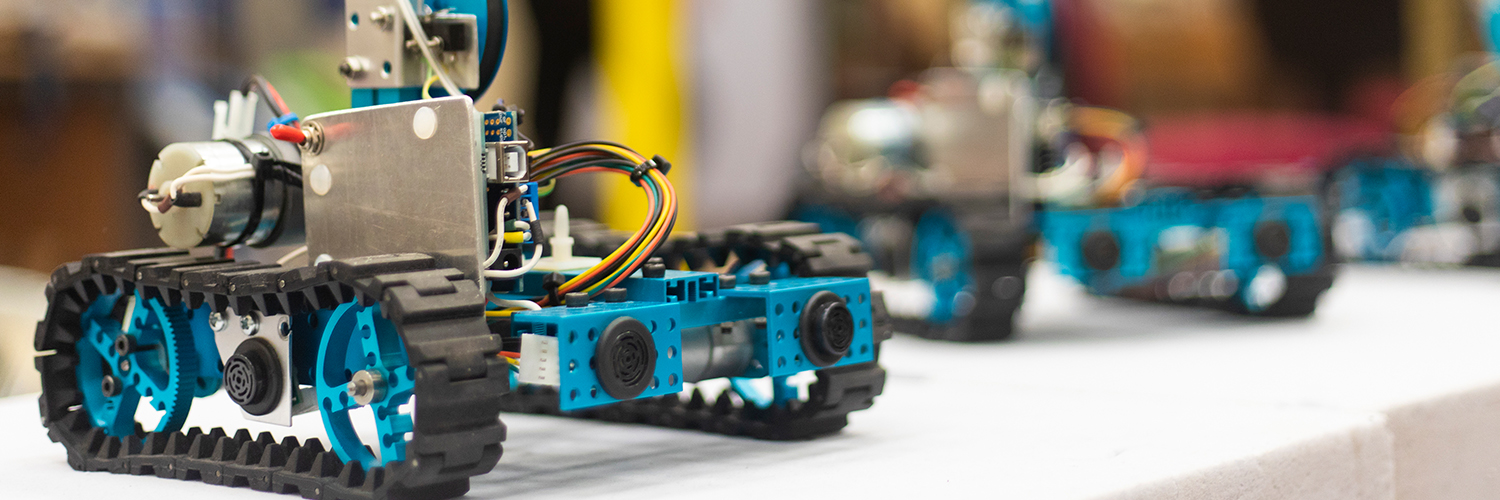
Our Autonomous Systems and Robotics laboratories feature an array of advanced equipment which include industrial robot arms (ABB Flexpicker, a six jointed Nachi arm, and a human-scale CRS robot), conveyor belt systems based on industry versions, plus a selection of wheel and leg-based mobile robot platforms.
Industry collaboration and research

When you start this degree, you are also joining a community making a difference in industry, our local region and in our wider society.
Many of our academics and technicians who support your course also deliver collaborative, interdisciplinary, high-impact projects and research that spans engineering, robotics and automation.
Supported by two decades of experience in automation and robotics, our Autonomous and Advanced Robotics (ASAR) Centre hosts one of the UK's largest international industrial-sponsored postgraduate programmes in robotics and automation. The Centre also provides degree apprenticeship training for Siemens.
Northern Engineering and Robotics Innovation Centre (NERIC)

Something exciting is on its way in 2023.
Our new Northern Engineering and Robotics Innovation Centre (NERIC) will be a focal point of our commitment to industry collaboration, innovation, and skills in an established and continually expanding area of expertise by providing a hub which adds value to the University’s and wider Greater Manchester technical infrastructure.
NERIC will be a beacon for the University’s robotics and automation specialisms, with the £16 million facility serving as a hub for small to medium-sized industries (SMEs) looking to design, test and validate innovation in this rapidly growing area.
How you'll learn
Future careers

EMPLOYMENT
At the heart of the Fourth Industrial Revolution (4IR), robotics and automation is rapidly developing, and adoption across a wide range of sectors and industries, including healthcare, retail, manufacturing and logistics, is gathering pace.
There is huge career potential in areas of robotic design, control systems integration and design, factory automation, and engineering management. As a robotics postgraduate, you can expect to find new and emerging engineering, technical and operational-based roles.
Read about Vincent's role at Dassault Aviation.
FURTHER STUDY
You might also choose to take your subject interest further with postgraduate research. Home to PhD and Research Master’s opportunities, our Autonomous Systems and Advanced Robotics (ASAR) Centre has internationally recognised research excellence in Robotics and Artificial Intelligence (RAI). A National Advanced Robotics Research Centre since 1987, the Centre is a spoke of the EPSRC Future AI and Robotics for Space Hub.
Modules
Course delivery
Drawing on our position as a leading UK robotics research centre, our MSc Robotics and Automation course is delivered through a range of highly-focused modules. The 180-credit MSc award comprises four taught modules, plus a research dissertation. The 120-credit PgDip comprises four taught modules. This programme is designed to meet the requirement of the Engineering Councils Accreditation of Higher Education Programmes (AHEP).
Flexibility is at the heart of our learning approach. You can choose to study this postgraduate course full-time or part-time on campus, with start dates in January and September:
- As a full-time student, you will complete four 30-credit taught modules in each of the first two semesters on campus. You will complete a 60-credit research project during your final semester
- As a part-time student, you will complete two 30-credit modules in semesters across the first two years of study. Across a further year of study, you will complete a 60-credit research project
The course timetable is designed to allow students with other commitments to structure their week around teaching sessions.
Learning experience
The course approaches robotics by providing a grounding in control engineering and intelligent systems concepts with practical experiences in hardware/software-based mobile robotics. Led by a research-active academic and technical team, the course is delivered in our advanced robotics laboratories. Practical experiences enable you to use robotics platforms, MATLAB toolboxes and programming languages, to produce hardware or software-based mobile robotics.
Current course topics include automation control systems, interactive visualisations, artificial intelligence and mobile robotics. The dissertation module is your opportunity to plan, manage and implement a robotics or automation project. Learn more about the current course modules in the section below.
Course team
The Robotics and Automation postgraduate course is delivered by an academic team with exceptional research experience and extensive professional connections.
Course leader: Guowu Wei
Semester one
Automation and Robotics
This module develops comprehensive knowledge of industrial robotics, applying mathematics and engineering principles to manipulator kinematics and control. You will formulate and analyse robotic problems to reach substantiated conclusions, using computational and analytical techniques for modelling and simulation, supported by critical evaluation of technical literature. Sustainability is considered through evaluation of environmental and societal impacts of automation. Practical laboratory skills are developed through ABB robot simulation and programming. The module also introduces engineering and project management principles within industrial and commercial contexts, including planning, implementation and evaluation of robotic systems.
Mechatronics
This module develops comprehensive knowledge of mechatronics, applying mathematics, science and engineering principles to electro-mechanical systems. You will formulate and analyse complex problems and apply computational and analytical techniques, supported by critical evaluation of technical literature. You will design integrated mechatronic solutions meeting user and industry needs. Practical laboratory work develops system integration skills using appropriate tools, technologies and processes. The module promotes inclusive engineering practice, effective teamwork and collaboration, and clear communication of technical outcomes to varied audiences.
Semester two
Artificial Intelligence
This module applies comprehensive knowledge of AI, mathematics, statistics and engineering principles to solve complex problems. You will formulate and analyse complex problems, evaluate data using first principles, and reach substantiated conclusions under uncertainty. You will select and apply appropriate computational and analytical techniques to model problems and critically evaluate technical literature. You will design AI solutions that meet user, societal and commercial needs. You will select and apply appropriate tools, technologies and processes, recognising limitations, and evaluate performance to support quality management and continuous improvement. A group project develops effective teamwork, leadership and evaluation of team performance.
Mobile Robotics
This module develops comprehensive knowledge of mobile robotics, applying mathematics, statistics and engineering principles to navigation, localisation and control. You will formulate and analyse complex robotic problems, applying computational and analytical techniques for modelling and implementation, supported by critical evaluation of technical literature. You will design autonomous robotic solutions meeting user and societal needs and consider environmental and societal impacts. You will select appropriate tools, technologies and processes and evaluate performance for continuous improvement. Project work develops engineering and project management skills, teamwork and effective communication.
Trimester Three
MSc Project/ Dissertation (Robotics and Automation)
You will work under the direction of an academic supervisor to carry out an advanced research or development project related to robotics and/or automation. As part of this project you will be expected to:
- Plan, manage and implement a project related to robotics and/or automation
- Utilise appropriate sources of information to carry out and produce a literature review
- Develop a framework for critical assessment and evaluation
- Organise an MSc Dissertation
We take a flexible approach to our course delivery that promotes diversity and inclusivity and provides a blended learning experience, which will vary to meet specific programme requirements. This learning time includes formal lectures and interactive activities such as seminars, tutorials, practical sessions, laboratory and studio learning. Smaller classes may be used to support collaborative activities such as project and group work and presentations. A range of different assessments and feedback is offered to meet the needs of both our diverse student body and specific subject needs.
Our postgraduate taught courses are normally made up of 30 credit modules which are equal to 300 hours of learning time, or 15 credit modules which are equal to 150 hours of learning time. A Master’s degree typically comprises 180 credits, a PGDip 120 credits, and a PGCert 60 credits.
Please note that exact modules and content offered may vary in order to keep content current and, for courses that offer optional modules, may depend on the number of students selecting particular options. When accepting your offer of a place to study on a programme with optional modules, you should be aware that optional modules may not all run each year. Your tutor will be able to advise you as to the available options on or before the start of the programme. Whilst the University tries to ensure that you can undertake your preferred options, it cannot guarantee this.
Entry requirements
APPLICANT PROFILE
This course is recommended for engineering-based graduates and experienced professionals who are fascinated by robotics, and want to be part of shaping how they will be part of our future.
ENGLISH LANGUAGE REQUIREMENTS
All of our courses are taught and assessed in English. If English is not your first language, you must meet our minimum English language entry requirements. An IELTS score of 6.0 (no element below 5.5) is proof of this, however we do accept a range of equivalent qualifications.
Read more about our English language requirements, including information about pathways that can help you gain entry on to our degree courses. If you do not have the English language requirements, you could take our Pre-Sessional English course.
INTERNATIONAL APPLICATIONS
Please check international intakes for the latest information and application dates.
Standard entry requirements
Undergraduate degree
A 2:2 honours degree, or equivalent qualification, in engineering or science.
International student entry requirements
We accept qualifications from all around the world. Find your country to see a full list of entry requirements.
Alternative entry requirements
Accreditation of Prior Learning (APL)
We welcome applications from students who may not have formal/traditional entry criteria but who have relevant experience or the ability to pursue the course successfully.
The Accreditation of Prior Learning (APL) process could help you to make your work and life experience count. The APL process can be used for entry onto courses or to give you exemptions from parts of your course.
Two forms of APL may be used for entry: the Accreditation of Prior Certificated Learning (APCL) or the Accreditation of Prior Experiential Learning (APEL).
For more information or enquires about this scheme, please contact: ScienceAdmissions-PG@salford.ac.uk
Fees and funding
Tuition fees are calculated pro-rata based on the full Master’s programme rate. PGDip fees will vary proportionally to the number of credits you study, as these qualifications require fewer credits to complete than a full Master’s degree.
2026/27
| Type of study | Fees |
|---|---|
| Full-time | £10,620 per year |
| Part-time | Calculated on a pro rata basis |
2027/28
| Type of study | Fees |
|---|---|
| Full-time | £10,800 per year |
| Part-time | Calculated on a pro rata basis |
2026/27
| Type of study | Fees |
|---|---|
| Full-time | £17,520 per year |
2027/28
| Type of study | Fees |
|---|---|
| Full-time | £18,000 per year |
Additional costs
You should consider further costs which may include books, stationery, printing, binding and general subsistence on trips and visits. International student scholarships If you are a high-achieving international student, you may be eligible for one of our scholarships. Learn more about our latest international scholarships.