

BSc (Hons) Physics
- Course type
- Undergraduate
- Course qualification
- BSc (Hons)
Course summary
What is the fee?
For all course options, see fees and funding
Where will I study?
Peel Park campus
What is the UCAS code?
F300
How long will I study?
Full-time: Three years
With placement: Four years
International students accepted?
Yes, available to international students
Overview
Physics helps us understand everything from the smallest particles in the universe to the technology we use every day. From smartphones and renewable energy to space exploration and quantum computing, physics is at the heart of the world's biggest discoveries and innovations.
On this Institute of Physics-accredited degree, you'll explore the fundamental principles that shape our world while building practical, computational and problem-solving skills through hands-on learning. Over three years, or four with an industry placement, you'll study a range of specialist topics and gain the knowledge, experience and confidence to pursue careers in research, technology, engineering, data science, education and beyond.
100% of Physics students at the University of Salford felt that their course was well organised and developed relevant knowledge and skills that they will use in the future. 100% of students also felt that their opinions on their course were valued by staff (University of Salford analysis of 2026 National Student Survey (NSS) results).
Through our engaging tutorials and laboratory-led activities, you will develop a greater understanding of the laws governing physics, strengthen your mathematical problem-solving and choose specialisms in acoustics or nanotechnology. We use small group teaching with friendly staff so that you feel supported and able to ask the questions that satisfy your enquiring mind in a safe and accessible environment.
You will:
- Explore the core principles of physics, from forces, energy and electricity to quantum mechanics, relativity and nuclear physics.
-
Discover how atoms, molecules and materials behave, and learn about the science behind modern technologies.
-
Understand how physics explains the world around us, from everyday devices to cutting-edge innovations.
-
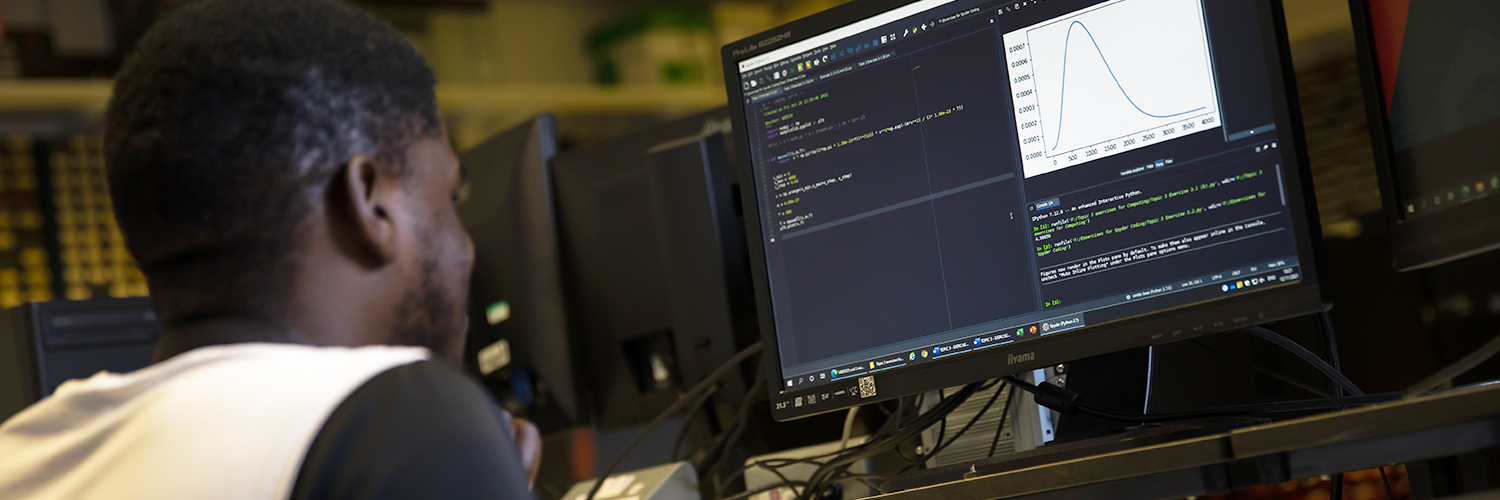
Gain hands-on experience using programming, mathematics and computer simulations to solve real-world problems.
-
Develop practical laboratory skills and learn how to design experiments, analyse data and communicate your findings.
-
Build valuable transferable skills, including teamwork, problem-solving, communication and presentation skills that are highly sought after by employers.
Your journey starts here
Ready to take the next step? Discover more by attending an Open Day, or speak to our dedicated course enquiries team for further information.
Course accreditations

This is for you if...
You’re excited about mathematics and physics and want to take your passion into higher education
You’re a problem-solver with an enquiring mind and a fascination about the world around you
You want to take your interest in physics into your future career, whether that is in industry, teaching or research
Facilities

As a physics student, you'll learn in our state-of-the-art laboratories in the £65 million Science, Engineering and Environment (SEE) building. Purpose-built facilities include specialist spaces for electronics, optics, lasers, computing and advanced materials, giving you hands-on experience with the tools and technologies used in modern physics. You'll also have access to our dedicated Laser Lab, Microfabrication Lab and Clean Room facilities, where you can explore cutting-edge research and industry applications.
How you'll learn
Future careers
Employment
A physics degree will equip you with a skillset and scientific approach so you can discover new scientific breakthroughs and innovations. Due to the analytical and problem-solving nature of physics, this degree can open up a wide range of career pathways.
As a physics graduate, you can look for opportunities in a diverse range of sectors, including healthcare, defence, finance, research, education, engineering and the nuclear industry. Physics graduates can also take routes into teaching or academic research.
Today, you will find our alumni working in roles at leading regional, national and international organisations, including NHS Digital, the Home Office, Barclays, Rolls-Royce, National Nuclear Laboratory, the Royal Air Force, Laser Quantum, Christie’s Hospital, and Airbus Defence and Space.
Further study
Building on our expertise, we offer a range of postgraduate courses that can take your interests and career opportunities further. Salford graduates and alumni who apply for our postgraduate courses also qualify to receive a generous fees discount.
- MSc Microsystems and Nanoengineering
- Materials and Physics Postgraduate Research
- MSc Aerospace Engineering
- MSc Data Science
Modules
Collaboration is core to our values, so we strive to embed this as a learning objective throughout your studies. You will experience group project opportunities that are linked to cutting edge research. These will build your confidence and capabilities in team working, problem-solving and communication - all desirable skills for real-world physics careers.
With your future in mind, in the first year of our physics course, one of the modules is taught through problem-based learning and involves direct collaboration with industry employers. We host a series of seminars given by industry professionals to talk to physics students about what they can do with their physics degree.
Our second-year physics students take part in a trimester-long group project, where students develop skills in areas such as computer interfacing and CAD design. Each group will design and build their own piece of physics-related equipment.
Industry placement
On this physics course, you'll have the option to take an industry placement year between years two and three. Although you'll be responsible for securing your placement, a tutor will support you, monitor your progress and assess your final placement report.
Read about Elizabeth's placement at the University of Salford Energy House and discover how she gained real-world industry experience.
Year one
Physics in Context
This module focuses on the underlying skills required in science and engineering. You will learn the importance of units, dimensional analysis, problem solving, presentation skills. We will also review the use of scientific IT, and introduce CAD/CAM and its application.
The module content will also highlight the relationship between these underlying skills and their role for scientists and engineers in the workplace. Seminars from various physics-based industrial organisations will give you the opportunity to consider your future employment options and outline what will be required to achieve your goals.
Physics Laboratory 1
In Physics Laboratory 1, you will learn core laboratory skills including measurement, data analysis and electronics. During the module activities, you will use these skills to undertake a set of experiments designed to complement the core physics ideas presented in other course modules.
The module is taught in the laboratory, facilitated by academic and technical staff.
Modelling of Physical Systems
The use of computers to support problem solving in physics is widespread in both academic and industrial research. During this module, you will explore the application of numerical modelling, demonstrating how it can be complementary to mathematical-based analytical techniques, often allowing the examination the characteristics beyond the limitations of standard approaches. The learning focus is on developing appropriate physical models and is applied to the core areas of mechanics, waves and thermal physics.
Electricity, Magnetism and Light
During this module, you will learn about the physical laws associated with electricity and magnetism and how the motion of charged particles is governed by electric and magnetic fields. Module content will also introduce the properties of electromagnetic waves.
The module is taught using a combination of lectures and interactive workshops.
Mechanics, Relativity and Quantum Physics
During this module, you will learn about the laws and applications of classical mechanics ,and how the principles of relativity and quantum physics adapt these laws to describe motion at relativistic speeds and of very small entities such as atoms and electrons.
The module is taught using a combination of lectures and interactive workshops.
Mathematics
Understanding and using mathematics is an essential skill for success in physics. During this module, you will review A-level standard mathematics topics covering algebra, trigonometry, functions, geometry, vectors, complex numbers and calculus, with emphasis on learning their applications to physics.
Year two
Quantum Physics
In this module, you will learn about the origins and principles of quantum mechanics. Both Schrӧdinger’s wave equation and the matrix formalism of quantum mechanics will be introduced, with applications in the fields of atoms and electrons.
The module is delivered using a combination of lectures and problem-solving tutorials.
Physics Laboratory 2
During Physics Laboratory 2, you will learn about experimental and computational methods applied in physics. You will undertake a series of experiments across a range of areas in physics, learn how to record results and link your findings to laws of physics. You will further develop computing skills and apply these to simulations in physics.
The module is delivered in laboratory settings with instruction and hands-on help.
Waves and Optics
Learn about principles of wave motion applied to mechanical, sound and electromagnetic waves. The module will introduce wave interference and build your understanding of diffraction in optical systems and applications. The module will also introduce underlying mathematical techniques including partial differential equations, Fourier transforms and convolutions.
The module is delivered using a combination of lectures and problem-solving tutorials.
Thermal Physics
During this module, you will learn about the laws of thermal physics and how the statistical properties of many particle systems relate to the laws in macroscopic systems. We will also introduce the concept of entropy and build your understanding of different states of matter.
The module is delivered using a combination of lectures and problem-solving tutorials.
Electromagnetism
You will learn about the fundamental laws of electromagnetism leading to the development of Maxwell’s equations and the electromagnetic wave equation. Underlying mathematical techniques, including vector calculus, will be introduced alongside the physical laws. The module is taught by a combination of lectures and problem-solving tutorials.
You will also choose one of the following elective modules:
Principles of Acoustics (Year one part time)
This module provides a general introduction into the subject of Physical Acoustics with an emphasis on sound radiation.
Group Project in Physics
This module is designed to bring together important aspects that are related to physics-based project work. You will learn:
- the use of CAD/CAM software in the context of design and development of complex scientific parts and models;
- how to construct simple sensor circuits and write interface software allowing automatic data collection;
- experimental design and construction, incorporating the CAD/CAM; and,
- interface skills, time management, teamwork and written/oral presentation skills via a group project.
Year three
Project in Physics
Working under the supervision of academic staff, you will conduct a research and/or development project. You will initially conduct background research into your chosen scientific area and produce a literature review highlighting the important history and progress made.
You will learn to work independently and be responsible for your progress (monitored by your supervisor). As part of your final assessment, you produce a professional scientific report outlining the progress made and present this work to an academic staff panel.
Nuclear and Particle Physics
You will receive an overview of Nuclear Physics and gain an understanding of nuclear stability in terms of the Liquid Drop Model and of nuclear reactions involving neutrons, protons, electrons and neutrinos, and major experimental techniques and practical applications. The particle physics element will cover the basic discoveries of modern Particle Physics and introduce the ideas of Grand Unified Theory.
Physics Laboratory 3
This module concentrates on the advanced physics laboratory skills required in science, engineering and the workplace. You can choose to focus on either experimental or computational physics.
You will build knowledge and gain the ability to use and understand the methodologies that underpin hi-tech materials deposition and analysis apparatus. Throughout the module, we will highlight the relationship between the module topics and their role to scientists and engineers in the workplace.
Condensed Matter Physics
You will learn how the fundamental laws of physics determine the properties of solids and liquids. The physics behind semiconductors and devices, magnetism and superconductivity will be developed. The module is taught by a combination of lectures and problem solving tutorials.
Astrophysics and Planetary Physics
Learn about the evolution of the universe, the structure and evolution of stars and galaxies and fundamental ideas in cosmology. In the planetary physics elements, you will learn about planetary formation, structure and the properties of matter under extreme conditions as found in the interior of planets.
The module is taught by a combination of lectures and problem solving tutorials.
We take a flexible approach to our course delivery that promotes diversity and inclusivity and provides a blended learning experience, which will vary to meet specific programme requirements. This learning time includes formal lectures and interactive activities such as seminars, tutorials, practical sessions, laboratory and studio learning. Smaller classes may be used to support collaborative activities such as project and group work and presentations. A range of different assessments and feedback is offered to meet the needs of both our diverse student body and specific subject needs.
Our undergraduate courses are normally made up of 20 credit modules which are equal to 200 hours of learning time. A three-year degree qualification typically comprises a total of 360 credits (120 credits per year).
Please note that exact modules and content offered may vary in order to keep content current and, for courses that offer optional modules, may depend on the number of students selecting particular options. When accepting your offer of a place to study on a programme with optional modules, you should be aware that optional modules may not all run each year. Your tutor will be able to advise you as to the available options on or before the start of the programme. Whilst the University tries to ensure that you can undertake your preferred options, it cannot guarantee this.
Entry requirements
Applicant profile
This physics course is designed for someone who is passionate about physics and science in general. We're looking for applicants with an aptitude for mathematics and problem-solving.
English language requirements
If you are an international student and not from a majority English speaking country, you will need IELTS 6.0 with no element below 5.5. We also accept a range of other English language qualifications. If you do not have the English language requirements, you could take the Pre-Sessional English course, or the International Foundation Year to gain entry onto this degree.
Standard entry requirements
GCSE
In addition to the following Level 3 requirements, you must have evidence of Level 2 GCSE English and Maths at Grade C/4 or above.
UCAS Tariff points
112 UCAS Tariff points.
A-level
Two full A-levels required as a minimum, including grade C in Maths and Physics.
BTEC
DMM in Engineering.
T Level
Subject to be reviewed on a case-by-case basis.
International students
We accept qualifications from all around the world. Find your country to see a full list of entry requirements.
Alternative entry requirements
Salford Alternative Entry Scheme (SAES)
We positively welcome applications from students who may not meet the stated entry criteria but who can demonstrate their ability to pursue the course successfully. Once we receive your application, we'll assess it and recommend it for SAES if you are an eligible candidate.
There are two different routes through the Salford Alternative Entry Scheme and applicants will be directed to the one appropriate for their course. Assessment will either be through a review of prior learning or through a formal test.
Not sure how many UCAS points you have? Use our UCAS Tariff Calculator to find out.
Fees and funding
2027/28
| Type of study | Fees |
|---|---|
| Full-time | £10,050 per year |
| Part-time | Part time fee will be calculated on a pro rata basis |
2027/28
| Type of study | Fees |
|---|---|
| Full-time | £18,600 per year |
The tuition fees shown are for the first year only. If your course lasts longer than one year, fees may increase each year in line with inflation, up to the maximum limits set by the UK Government.
Additional costs
You should consider further costs which may include books, stationery, printing, binding and general subsistence on trips and visits.
Scholarships for international students
If you are a high-achieving international student, you may be eligible for one of our international scholarships to study physics.
How to apply
Still have some questions? Register for one of our Open Days or contact us:
- enquiries@salford.ac.uk (UK applicants)
- +44 (0)161 295 4545
Enrolment dates
Student information
Terms and conditionsUCAS information
Course ID F300
Institution S03